THE Royal Arch in Ireland has a long history. The Youghal reference to the “Royal Arch” in 1743, the Youghal minute of 1759, Fifield Dassigny’s book of 1744 – all these have already been cited in this book as indicating the early acquaintance of the Irish freemason with the Royal Arch ceremony. Ireland took its Craft freemasonry from England in the 1723 period, probably via Bristol. The Irish freemasons were far from appreciating the condescension of the English Grand Lodge, whose Constitutions of 1738 announced that the lodges of Scotland, Ireland, France, and Italy were “affecting independency”; behind this curious phrase there lay the implication that there was one Grand Lodge, the English, and that all others owed allegiance to it. The alterations made by the premier Grand Lodge in its effort to fight clandestine masonry alienated masons in England and many other countries, particularly Ireland, and it inevitably followed that as soon as the Antients’ Grand Lodge of England found itself established it entered into close association with the Irish Grand Lodge, which body, early in 1758, wrote stating that it “mutually” concurred in a strict union with the Antients’ Grand Lodge, and promised to keep in constant correspondence with it. In 1772 there came about a reciprocal arrangement by which Irish masons in England and the Antient’ masons in Ireland received “all the honours due to a faithful Brother of the same Household with us.” In the following year the Grand Master of Scotland wrote expressing the wish to establish “Brotherly Intercourse and Correspondence” and repeating the phraseology of the Irish Grand Lodge’s letter.
Thus we find the Antients’ recognizing fully and completely the sister Grand Lodges of Ireland and Scotland, but in this mutual recognition there was a remarkable anomaly: in English masonry a great, and perhaps the greatest, difficulty as the eighteenth century developed was the Antients’ love of the Royal Arch and the Moderns’ hostility to it. Yet the Grand Lodges of Ireland and Scotland officially regarded the Royal Arch more or less as the Moderns’ did! In England the Moderns’ did not officially cease their hostility until 1813, but in Ireland, whose Grand Lodge was, also officially, just as hostile to the Royal Arch, there was no Grand Chapter until 1829, and in Scotland none until 1817, in which latter year some, but far from all, of the Scottish chapters came into one jurisdiction.
The good understanding between the Antients’ and the Irish Grand Lodge is best exemplified in the fraternization of their military lodges abroad. Here is a revealing example: The Irish military lodges stationed at Gibraltar in the 1790’s supported the Antients’ Provincial Grand Lodge of Andalusia (a division of Southern Spain), paid contributions to the Antients’ Grand Lodge in London, although retaining their Irish allegiance, and were ordered by their own Grand Lodge to submit to the ruling of the Provincial Grand Lodge of Andalusia!
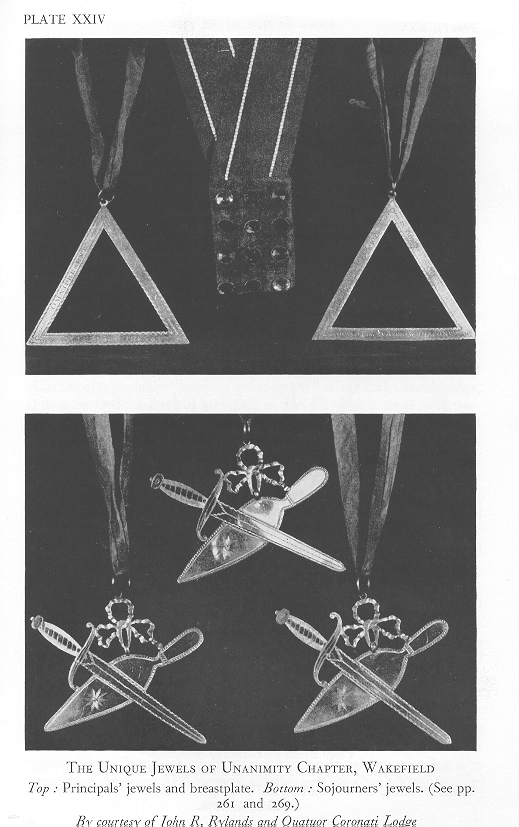
In the decades immediately before the end of the century the official Irish attitude to the Royal Arch was frankly hostile. In 1786 the Grand Lodge banned Royal Arch entries in lodge minute‑books, although in the following year, and again in 1805, it tried, but failed, to gain control of the Royal Arch and other degrees. On June 11, 1829, fifty‑three chapters constituted themselves into a Supreme Grand Royal Arch Chapter (following the pattern of Supreme Grand Chapter of England that had been founded about twelve years before). It has been said that the new Grand Chapter was given the “blessing and approval” of the Irish Grand Lodge, but at the beginning it had very little power, although it could issue warrants. Its officers were three Grand Principals, three Sojourners, First and Second Scribes, with a High Priest as Chaplain. When, in December 1829, the regulations were formally adopted 158 chapters had already applied for warrants. In the following year it resolved that recognition be refused to chapters that were without warrants and that the presiding officers of subordinate chapters be styled Grand Masters, and not High Priests.
Many Dublin lodges quite early in the 1800s were working the Royal Arch, two of them being known as “Royal Arch Lodges,” but an agreement which was bound, in the long run, to kill the old custom of conferring the degree in lodge was arrived at in 1834, by which time the Grand Master and his deputy (Craft) had automatically become Grand Principals. This agreement, to be found in print in the Irish Ahiman Rezon of 1839, provides that Companions excluded or suspended or restored by Grand Chapter should suffer the like treatment by Grand Lodge and vice versa; no lodge could hold a chapter unless it had previously obtained a warrant for it, but in practice this law was often disregarded.
Although the Grand Chapter came into existence in 1829 with the Irish Grand Lodge’s “blessing and approval,” not until 1931, 102 years later, did the Grand Lodge, in response to a memorial supplicating it to recognize the Royal Arch degrees, add this new law (No. 2A):
Pure Ancient Masonry consists of the following Degrees and no others, viz: ‑ The Entered Apprentice, the Fellow Craft, the Master Mason and the Installed Master, but the degrees of R.A. and Mark Master Mason shall also be recognized so long as the Supreme Grand Royal Arch Chapter of Ireland shall only work those two degrees in the form in which they are worked at the passing of this Law.
The Irish Grand Lodge based its custom of issuing warrants upon that of the Antients.’ Over a long period the ordinary lodge warrant was regarded‑at any rate by the lodges themselves‑as conferring the right to work the Royal Arch and such other unspecified degrees as were customary at the time, and it is known, for example, that Belfast lodges and chapters in 1842 were conferring the degree of Knights Templar under their ordinary warrants.
As from the establishment of the Grand Chapter in 1829 the Craft lodge warrant was commonly called a “Blue Warrant” (American practice perpetuates this), and the chapter warrant a ” Red Warrant.” The term ” Craft Warrant” was not used officially of an Irish warrant until 1875.
Step and other Degrees in Ireland
The Royal Arch became in quite early days popular in Ireland in spite of the lack of official recognition, and in the course of time, and probably as a reflection of English practice, it gathered to itself a small collection of added degrees, some of them step degrees leading up from the Craft, while others were Christian degrees to which the Royal Arch itself acted as an introduction. That no secret was made of the existence of these degrees is obvious from the following advertisement in Dublin journals of 1774:
The Knights Templars of Ireland, Royal Arch, Excellent and Super Excellent Free and Accepted Masons, Lodge No. Sob, intend dining together at their Lodge‑room, at the Thatched Cabin, Castle St., on Friday, 24th instant to celebrate the Festival of St. John; Such of the Fraternity as chuse to Dine with them are requested to leave their Names at the Bar two days before, Signed by Order, J.O. E.G.S. (E.G.S. would represent ‘Excellent Grand Scribe’.) Dinner to be on the Table at Four O’Clock.
The Rose Croix is believed to have been introduced into Dublin in 1782 ‑ “years before any trace of the Degree, or the Rite to which it belongs, is found in any other English‑speaking jurisdiction,” says Chetwode Crawley.
There was the customary sequence of degrees at the making of a Royal Arch mason in a Craft lodge in Lifford, County Donegal, in 1785, when a Brother was made Excellent and Super Excellent before he was exalted in a Craft lodge. In 1786 the title‑page of the by‑laws of Irish lodge No. 620 mentioned the above degrees, and followed them with the Knights Templar; then, bearing date 1789, a parchment certificate is impressed with the Craft, Royal Arch, and Knights Templar seals of the Lodge. The Knight Templar Degree was commonly conferred in Irish Royal Arch chapters; indeed, in 1836 it was “irregular” to attach a Knight Templar encampment to a lodge that had no Royal Arch chapter connected with it.
Banagher Lodge, No. 306, opened and closed a Past Master’s Lodge in June 1794; then it opened a Royal Arch chapter and confirmed the proceedings of the last chapter and of the P.M.’s Lodge; Brethren who had been advanced to the Chair Degree were then made R.A. masons, the fee being two pounds. The chapter funds were combined with those of the lodge, “both being held for the common good,” and chapter and lodge were subject to the same laws so far as they were consistent.
The minutes of a lodge or chapter at Castle Bar in the year 1816 appear to be typical. Two Brethren were exalted to the Degree of “Royal Arch Super Excellent Mason.” The High Priest gave a lecture and the chapter was closed, “after which the Lodge was transferred to the Third or Master’s Degree of Masonry.” The chief officer was the High Priest, and assisting him were the First, Second, and Third Grand Masters. Other minutes of this lodge are on similar lines.
There was a tendency for the Excellent and Super Excellent Degrees to disappear as such from the Irish R.A. They are not mentioned in the Irish Ahiman Rezon of 1839, and it was at one time presumed that officially they were extinct in the 1840痴, but lodge minutes still show them as being worked. In Lodge 1012 in 1843 a Brother passed the chair, was made Excellent and Super Excellent, passed the First, Second, and Third Veils of the Temple, was made an R.A. mason and subsequently a Knight Templar; two years later, in this lodge, a Brother passed through the same sequence and paid as fees 」1 11s. 4d.
The High Priest’s Position
The principal officer of an Irish chapter was the High Priest, and this was so for a long period, but the Irish Grand Lodge (founded in 1829) brought about an alteration and ordered that the presiding officers of subordinate chapters should be known as Grand Masters, with the result that the High Priest sank to the bottom of the list of the nine officers then “ordained.” At the same time the names of the Principals in an English chapter began to be heard in the Irish chapters, but this introduction was not popular and not everywhere adopted. The High Priest, who had been the chief officer of the assembly, chapter, or lodge (all three terms were in vogue) had in some cases now become simply the Chaplain, but it was difficult for the Scribe E. always to remember the alteration, and his minutes were subject to vagaries in this particular matter. By 1858 the presiding officers in quite a number of chapters were still known as the First, Second, and Third Principals, the High Priest taking a minor place, but, following the work of a special committee, an additional officer – the King ‑ became in 1861‑62 the First Principal, while the Chief Scribe, who since 1839 had been seventh in the list, advanced to third place. The Sojourners, so called, now disappeared, and as such have no place in Irish ritual to‑day, the Brethren assisting the Candidate in the repairing of the Temple being known as Craftsmen.
There was a period early in the nineteenth century when many Installed Masters found themselves, as a result of lack of facilities for obtaining instruction, incapable of conferring degrees, and had to resort to the services of some expert Brother, in which connexion J. Heron Lepper has explained that the Master continued to preside over the lodge, but there was a “Degree Giver,” who remained close to the Candidate all through the ceremony, an arrangement favoured by the form of an Irish lodge. The following brief extracts from Irish minutes illustrate the point: “Worshipful A.B. in the Chair. C.D. and E.F. was Initiated by Jas. Quinn” (1834); “a night of emergency. Bro. A.B. in the Chair. . . . Bro. C.D. was made a Royal Arch Mason and consequently Made a Knight Templar mason. Received the instructions from Bro. G.H.” (1840); “Bro. C.D. was made a Master Mason…. Bro G.H. done the business that was required” (1842); three Brethren were made “pass masters in the Chair, etc…. paid Bro. G.H. 5s for giving instructions this night” (1843); ” gave Bro. G.H. 11/4スd. for his trouble to come to instruct the Lodge” (1803). (All these minutes are more fully quoted in A.Q.C., vol. xxxv, p. 183.) It goes without saying that the custom is now obsolete. (There are still some aspects of masonry in the relatively large American lodges which apparently reflect but do not quite reproduce the old Irish custom.)
The Three Principals
The First Principal of an Irish chapter has always, right back to the earliest days, been a Past Master in the Craft, actual or virtual, and the secret instructions relating to all three chairs are essentially the same, irrespective of names and designations, as in Irish, English, and Scottish constitutions. However (by special permission of the Irish Grand Chapter) neither the Second nor the Third Principal is necessarily a Past Master, but, if he is not, he must so inform any chapter under another jurisdiction which he may happen to visit. All three must be Mark Master Masons and have been registered as Master Masons for five years at least. The Excellent King elect must also have served the office of High Priest or Chief Scribe and have been installed as Master in a Mark lodge.
There is a general impression that esoteric ceremonies associated with the Principals’ chairs are, in general, not older than fairly late in the nineteenth century; a ritual of 1864 includes a ceremony for the “Installation of a King, within a Royal Arch Chapter,” and it is known that somewhere about the 1890s all Principal Officers of subordinate Irish chapters had to be re‑obligated in order to conform to an arrangement arrived at between the Grand Chapters of Ireland and England; prior to that period it is likely that only the King and not the other Principals was obligated.
The chief officers of an Irish chapter nowadays are the King, High Priest, and Chief Scribe. Other officers are the Captain of the Host, Superintendent of the Tabernacle, R.A. Captain, three Captains of the Veils, the Registrar, and the janitor; there may also be a Treasurer and a Chaplain. Up to 1922 the Three Principals collectively were addressed as “Your Excellencies” and the First Principal as Most Excellent King, but nowadays the term “Most Excellent” is reserved for the Three Grand Principals, “Very Excellent” for Grand Officers, and “Excellent” for Principals of subordinate chapters.
Grand Officers
The chief officers of the Grand Chapter are the Most Excellent Grand King, High Priest, and Chief Scribe. The most important of the Grand Officers are the Grand King, his Deputy, Grand First Principals of District Grand Chapters, Provincial Grand Superintendents, the Grand High Priest, the Grand Chief Scribe (all “Most Excellents”); the Grand Treasurer, the Grand Registrar, the Grand Director of Ceremonies, the Grand Chaplain (all “Right Excellents”); the Grand Captain of the Host, the Grand Superintendent of the Tabernacle, the Grand Royal Arch Captain, the Grand Captain of the Scarlet Veil, and the Grand Captain of the Purple Veil and the Grand Captain of the Blue Veil (all “Very Excellents “); then the Grand Standard‑bearers, the Grand Janitor, the Grand Very Excellent Registrar of the Grand Chapter of Instruction, District Grand Officers, Officers of the Grand Master’s Chapter, and the Excellent King, High Priest, and Chief Scribe of every subordinate chapter. Grand Officers are nominated at the July convocation of Supreme Grand Chapter every year, elected at the November convocation, and installed and inducted in February. (The remaining “Stated Convocation” of Grand Chapter is in May.)
Chapter officers are elected annually, and their names must be approved by Supreme Grand Chapter before Installation (if overseas, then by the Provincial Grand Superintendent). Each of them must be a subscribing member of a Craft lodge, in good standing, and not in arrears in any lodge or chapter. A Principal Officer cannot resign office until the termination of the year for which he has been elected; in his absence a Past King shall rule the chapter.
Clothing
The full‑dress apron of the Order is of white lambskin, 12 inches to 14 inches deep and from 14 inches to 16 inches wide, bordered with scarlet ribbon 2 inches broad, having in the centre half‑inch gold lace; the flap has a border 1l inches broad and carries a triangle of silk or satin, edged with a gold border, and within the triangle, the triple tau, of gold‑spangled embroidery. The silk or satin ground is scarlet for Kings and Past Kings and white for all other Companions.
The sash, of plain scarlet ribbon 4 inches broad, is worn under the coat from right shoulder to left hip, and has a triple tau at the tie. The sashes of Grand Officers, etc., including those of Kings, have their ends trimmed with gold fringe 2 inches deep; the sashes of all other Companions have a silk fringe.
Collars carry either three or two bands of half‑inch gold lace according to the importance of office; chains of office and gauntlets are worn by the more important Grand Officers.
Jewels of office are suspended from collars of scarlet‑ribbed silk, trimmed with half‑inch gold lace and, in the case of Grand Officers, etc., gold fringe 2 inches deep.
The jewel of the Order is worn on the left breast‑on Companions it is pendant from a white ribbon; on the Principal Officers, etc., from a scarlet ribbon. (Grand Chapter specifies the apron and jewels of office to be worn by Mark Masters.)
The Candidate and his Qualifications
A Candidate for the Royal Arch must have been registered as a Master Mason for six months (one month for Naval, Military, or Air Force Brethren), and must be a Mark Master Mason and a subscribing member of a Craft lodge. The Mark Master Mason Degree must be worked under the jurisdiction of Grand Chapter and conferred only on Brethren who are Master Masons and who actually have been proposed and balloted for Exaltation in chapter; Brethren either residing in Dublin or proposed for Exaltation in a Dublin chapter must be approved by the Committee of Inspection, consisting of the Grand Officers and the King of every subordinate chapter meeting in the Dublin district. It meets monthly and does not consider a Candidate until after he has been balloted for and approved by the chapter which he proposes to join.
The chapter ballot takes place in the presence of either the proposer or the seconder; every member present must ballot; the Candidate fails to be elected if there are more than two negatives in the ballot.
The degree is not conferred upon more than three Candidates at one time, and neither the Mark nor the R.A. Degree may be divided or curtailed.
A memorial for a warrant to constitute a new chapter must be signed by at least nine R.A. masons, who must also be Mark masons and Master Masons of at least five years’ standing and be subscribing members of a lodge under the Irish Constitution.
Ceremonial, Exaltation Ceremony, etc.
The Irish Grand Chapter prescribes approved ceremonies for constituting new chapters and for installing officers and prescribes the prayers and charges and the Scriptural readings used in chapters. Indeed, every chapter is required to conform with the established ritual, failure involving a fine or even the cancelling or suspension of the warrant. Further, all matters of ritual or ceremony are subject to the approval of the Grand Chapter of Instruction, which consists of the most important of the Grand Chapter Officers together with other experienced Brethren of rank and standing elected for the purpose.
The quorum for a chapter is six Companions, including the Three Principal Officers, but for conferring a degree nine must be present during the entire ceremony.
An Outline of the Exaltation Ceremony
The Opening Ceremony includes reference to the Captains of the Veils and their places, one outside the blue, one outside the purple, and one outside the scarlet veils, their duties being to guard their veils. The colours of the veils are symbolic. The place of the Royal Arch Captain is outside the white veil (purity) at the entrance to the council chamber, and his duty is to guard that veil. The Captain of the Host has a place in front of the Three Principal Officers. The Chief Scribe is in the East, at the left hand of the Excellent King, the High Priest being at his right hand. The exaltee wears the Mark Master Mason’s apron. An officer of considerable importance is the Conductor, whose duty is to announce and instruct the exaltee, to lead him in a devious way and introduce him to the veils which he duly passes. The exaltee is encouraged to persevere in his desire to recover that which was lost and to engage in the search for truth. Though there are no 全ojourners’ so called, Companions act with the exaltee to bring the number of Craftsmen to three. The Craftsmen, having begged permission to assist in the work of repairing the Temple, are given implements as in the English rite, but the explanations are different. Symbolically, the pick roots out from our minds all evil thoughts; the shovel clears away from our minds the rubbish of passion and prejudice; and the crowbar raises our desires above the interests of this life, the better to prepare for the search after knowledge and the reception of truth and religion.
The discoveries are dramatized more or less in view of the chapter. The Craftsmen, standing on what is represented to be part of the foundations of the Temple, clear away the rubbish and raise a stone slab which gives entrance to an arched vault. The exaltee is actually lowered into the vault, and there he makes certain discoveries, among them being the squares of the three Grand Masters; ancient coins of Israel and Tyre; a medal bearing the interlaced triangles and the triple tau; a plate of gold on which is engraved the sacred Tetragrammaton; a cubical stone on which has been sculptured certain initial letters; and, lastly, a copy of the Sacred Law. The later development of the ceremony is on familiar lines. The sash, as explained, is worn from the right shoulder so that the triple tau comes at the left hip.
Royal Arch Certificates
The earliest‑known Masonic certificates are Irish, and all the Irish RA. certificates have a style of their own. Here is one dated 1795, issued in Cookstown, County Tyrone:
We the High Priest & & & of the Royal Arch Super Ex! Encampment of No. 553 On the Registry of Ireland Do Certify that ‑ ‑ ‑ past Master of said Lodge & Was by us Installed and Initiated Into that Most Noble & Sublime Degree of Royal Arch Super Ext Masonry he having suported the Amazing tryal attending his Admittion With courage fortitude And Valiour & as such We Recommend him to all Worthy Royal Arch Super Ext Masons Round the Globe; Given Under Our Hands & Seal of Our Grand Charter Held In the house of Br Jas Gray In Cookstown In the County of tyrone In Ireland, this 11th Day of May 1795 & of Royal Arch Super Ext Masonry 3795.
This is signed by officers describing themselves as High Priest, Grand Master, Senior Warden, Junior Warden, and Secretary.
A second example, dated 1801, is a certificate preserved at Freemasons’ Hall, London; it is printed (except for names and date) on a large sheet of paper bearing more than fifty symbolic illustrations:
In the name of the Most Holy and Undivided Trinity, Father, Son and Holy Ghost. We, the High Priest, Captain General, and Grand Masters of a Royal Arch Super‑excellent Masons Encampment and Grand Assembly of Knight Templars under the sanction of the Carrickfergus, the Blue [Craft] Lodge, No. 253, on the Registry of the Grand Lodge of Ireland, do hereby certify that our beloved Brother the Worshipful Sir Peter Mathews having duly passed the chair of the aforesaid Lodge was arched a Royal Arch Super‑excellent Mason, and was subsequently dubbed a Knight of the Most Noble and Worshipful Order of Knights Templars, after having withstood with skill, fortitude, and valour, the amazing trials attending his admission. Given under our hands and the seals of our Grand Encampment and Assembly aforesaid this 2ist day of August, 1801. A.L. 5801
This is signed by officers describing themselves as High Priest, Captain General, and two Grand Masters.
A third example, a certificate issued by a chapter in Wexford in 1850, well maintains the hyperbolical language:
WE the HIGH PRIEST, etc, etc, of the Grand Chapter of ROYAL ARCH super‑excellent MASONS, of Lodge 837, in the Town of Wexford and on the Registry of IRELAND, DO hereby certify the Bearer hereof, our trusty and well‑beloved Brother Past Master of said Lodge, was by us INSTALLED, and INITIATED in that most noble and sublime Degree; he having with due Honour and justice to the Royal Community, truly supported the amazing Tryals of Skill and Valour attending his admission; and as such we him recommend to all true and faithful ROYAL ARCH SUPER‑EXCELLENT BROTHERS around the Globe.
Although the above certificate is of comparatively late date, it is signed by the High Priest, the Royal Arch Captain, the Grand Master, and Senior and Junior Grand Wardens, all of them officers of the lodge.
A certificate issued by Ballina Lodge, No. 548, in 1820, includes a recommendation of the Brother “to all the Sublime Lodges and brethren who understand the angles and squares of 3 x 3.”
An Irish Masonic Funeral
Funerals of prominent and well‑beloved Brethren and Companions were frequently of an imposing order. The Limerick Herald, in two issues of the year 1820 recording the death and funeral of Francis Wheeler, described at length the elaborate funeral procession, with its three bands, that accompanied the coffin to its resting‑place, and particularly mentioned the inclusion of the “Royal Arch, with the Lodge within, borne by two Brethren and covered with crape.” Apparently there was a printed order of procession, and this included a monody (an ode expressing grief), in which occurs a reminder of an ancient funeral custom:
The wands there brok’n for the dead
Form’d Royal Arches o’er his head.
During some hundreds of years there was a custom by which a chief mourner ‑ perhaps one whose authority passed with the death of the individual then being buried ‑ broke his wand of office and threw the fragments into the grave. Other instances are given in the present author’s earlier book.