The Royal Arch
Having passed three degrees of Craft masonry, the Royal Arch, justly deemed the completion of the Master Mason’s degree, has to many appeared a somewhat confusing ceremony that does not teach a clear message, unlike those of the preceding degrees.
Whilst the meaning of Craft Masonry is understood or explained clearly to most Brethren as the messages the degrees teach are self-evident, the meaning of the Royal Arch ceremony is rarely discussed in any detail either in or outside of lodge.
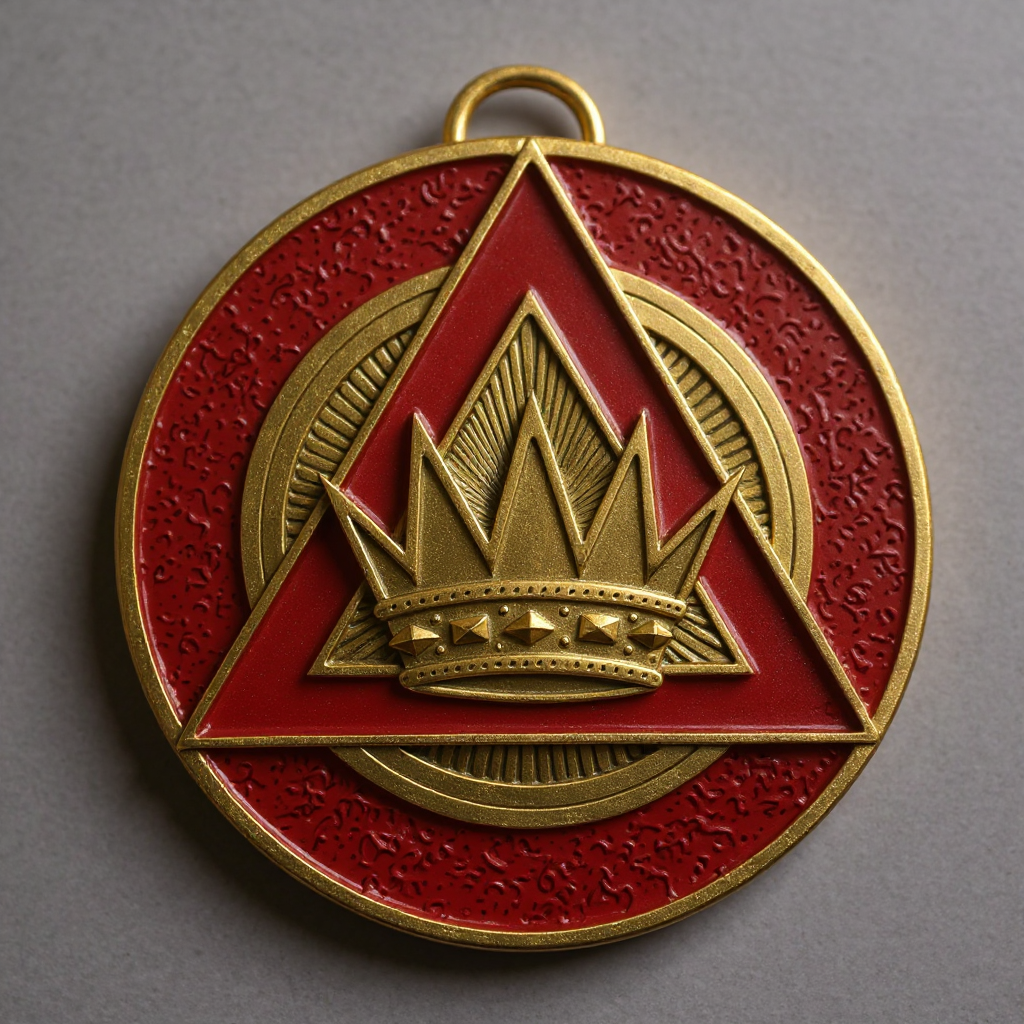
An Introduction
Craft masonry is concerned with our mortal existence; birth, life and death. It inculcates values and morals, through operative symbolism, which are immediately understandable and can be assimilated by the diligent application of the tenets taught therein.
Our duty to our fellow men and Brethren and the respect due to our Creator are laid out clearly. The ritual allegory of the Master Mason degree teaches us how to approach the moment of death without fear and with honour.
The Royal Arch is however concerned, not with our mortal life, but with the next and with our relationship with the Creator.
It contains much symbolism and a more complete understanding of this degree then charges us with a clear task, to rediscover the truth regarding the Most High.
The ceremony is highly esoteric and as many Royal Arch masons do not reflect on the degree and few brethren are willing to express their perception on the lesson taught by the degree, the impact is frequently far less than those of the preceding degrees.
Some of the themes contained in the Royal Arch ceremonies benefit from expansion and attempts can be made to show that it exemplifies much esoteric philosophy and symbolism, thus being perceived as a metaphor for the process of reintegration with the Creator.
The Talmud tells us that;
“Man’s soul is from heaven and his body from earth. The body is the scabbard of the soul”.
The Royal Arch encapsulates and mirrors particular aspects of this. The Master Mason’s degree completed by the Royal Arch can be seen as an allegorical and veiled description of the Fall of Adam Kadmon, the qabalistic first man and the subsequent reintegration of man into the Light from which he originated..
Further Study
As we study the form, structure, officers and ornaments of the Chapter, many symbolic aspects can be identified and the underlying meaning of the Royal Arch degree can be interpreted to show an esoteric philosophy concerning reintegration.
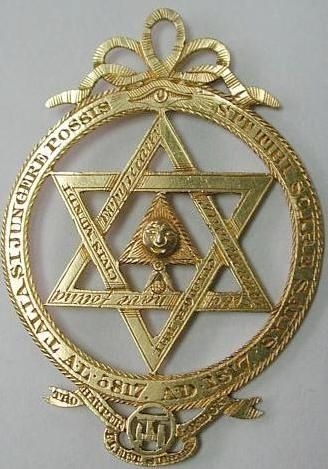
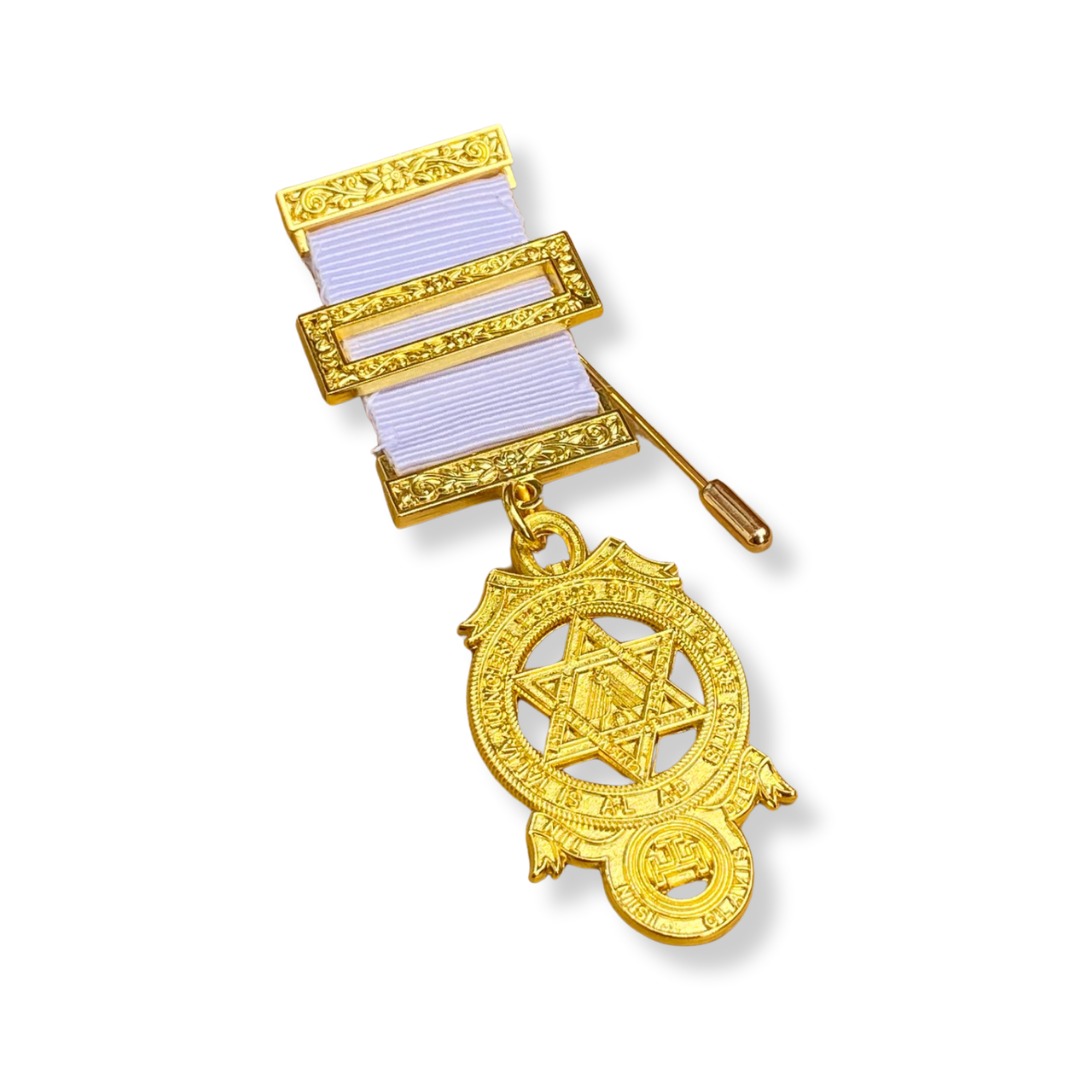
The jewel of the Royal Arch is the hexagram, the Seal of Solomon, which unites the heavenly and mundane worlds, and in itself is a codex for the union of the Microcosm and Macrocosm, two separate and yet identical in nature reflections of each other.
It further can be seen to describe the relationship of the Craft and the Royal Arch. The Craft degrees represent the lower worldly domain, and the Royal Arch, the upper heavenly domain.
Upon the jewel are written the words: Nil nisi clavis deest, “nothing but the key is wanting”. Many suggest that the key is in fact the realisation that the degree is an allegory of the inner search for God within all of us.
Also inscribed is the phrase: Si talia jungere possis sit tibi scrire satis, “If thou canst understand this, thou knowest enough”. Whether this refers to the key of the degree, or the meaning buried within is unclear, but can relate equally to each.
The Craft consists of three degrees, ruled by one Master. The Royal Arch conversely has one ceremony, with three rulers.
Geometrically, these produce two opposing equilateral triangles. In itself the triangle is a deep qabalistic device, with multiple correspondences and meanings within Masonry and from Pythagoreanism through Neo-Platonism to Rosicrucianism.
The triangles displayed in the jewel recall the alchemical representations of the elements of water and fire. The whole in combination represents reintegration alchemically by the combined forces of water and fire, putrefaction, disease and the union of God and the Universe, again underlining the Oneness of all.
The Sojourners
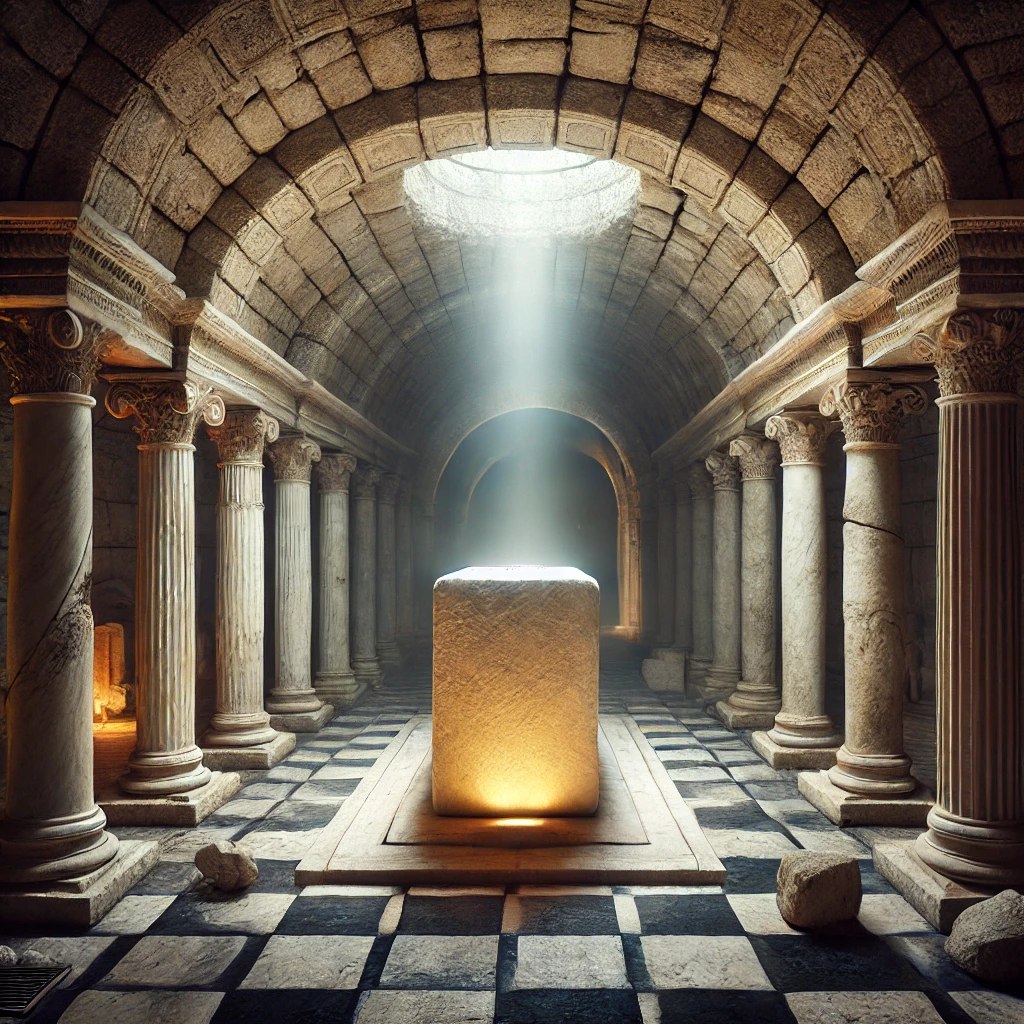
The three sojourners discover the underground vault in the ruins of the first temple.
The ritual of the Royal Arch describes the discovery, buried within a long-forgotten vault, of the sacred name of God.
The candidate, tasked with clearing a building site discovers an arch or dome of stone, from which he removes the keystone and opens the vault, penetrating the depths until, with his companions’ assistance, he discovers the word, deposited within.
The ritual describes the response of the candidate when asked what he found as “For the want of Light I am unable to discover”… that Light is the true Key and is the discovery by the Candidate, through reflection, that God is at the centre of our very being.
The Word
The traditional sacred word of the Royal Arch can be seen to be a philological metaphor of the unity of the Great Creator. Prior to the changes imposed by the Supreme Grand Chapter of England in 1989 in response to strong media and Church pressure, and still in use in other jurisdictions worldwide, one of the sacred words was a synthetic and syncretic threefold glyph for the name of God.
This compound word unites the name of God from three different belief systems, and underlines the belief that there is but One Light, manifested in myriad ways and perceived differently by different groups of mankind, but arising from a single source. The word can therefore be seen as a metaphor for the unity of the Light and the One.
The other (and under the UGLE presently the only) Judaeo-Christian sacred word is used in Gnostic belief systems to represent the same unifying and unitising principle of the One True Light.

Allegory
The allegory of the Royal Arch degree is therefore the inner discovery of that which was lost previously. The goal of restoration and reintegration is predicated by the concept of the Fall of Man from grace, the loss of synergy with the One and the undoing of his spirit which must be counteracted by own internal search for the truth within us.
One common doctrine of eschatology states that in the End all will come back to the Beginning. Reintegration will restore that which is lost.
The Masonic and Royal Arch allegory tell us that the genuine secrets of the Master Builder were lost by the untimely death of Hiram Abiff, and that in the Royal Arch we will rediscover the genuine secret, or more specifically, the name of God.
The Royal Arch can thus be seen as the discovery, deep within each of us, of the One True Light; that Consciousness can be found within ourselves through our labour.
Job 19:26 says ‘in my flesh I shall see God’. The candidate becomes the apotheosis of mankind, discovering the Divine within and restoring himself to his original state.
The Story
In the Royal Arch story, the three Sojourners belong to a tribe that fell from grace; the captivity in Babylon shows a parallel to the fall of Adam Kadmon, from freedom and liberty in light to enslavement and darkness in servitude.
In the Royal Arch degree, the sojourners regain their former status; namely through their discovery they experience Reintegration.
In Haggai 2:3-9 the Lord asks of the Jews who had seen this house (of God) in its former glory, and how it seems now as nothing.
But that the glory to come will eclipse the former. The whole of Haggai may be viewed as a metaphor for the fall of Man and the prophecy of Reintegration into Unity.
In the traditional Scottish version of the Royal Arch, the arch is depicted as being supported by two pillars, united by the keystone of the Mark Master Mason degree and subsequently constructed during the Most Excellent Master degree.
These pillars not only represent those described in Craft masonry, but also the two opposing pillars of kabbalistic dualism.
God found within is further symbolised by the figure of a point within a circle, bounded by two parallel lines; the point of Unity within the whole of Existence, and the One True Religion within the sphere encompassing all forms of worship, juxtaposed by the two lines representing the antagonistic forms of nature and the dualism of opposites.
The Point within a Circle is the Unity Principle within the centre of Eternity and represents Reintegration.
As a minor diversion it is useful to acknowledge that this is a symbol of great antiquity, being first described by the cosmology of the Pythagorean philosopher Philolaus in the 5th century BCE as relating to the Limited (or point of focus) within the Limitless.
This was the first historically recorded non-geocentric view of the world, and Philolaus posited the existence of a central great fire or light around which everything harmonised.
The Principals
The Three Principals of the Chapter likewise are a further expression of the Triune expression of Light, as the triumvirate rule as one, each having distinct and separate characters; one representing the law, one knowledge and the last worship.
This has a distinct qabalistic formula, 3=1, and in Pythagorean teaching, the number three is the first with substance, the first geometric figure and that which signifies manifestation.
In addition, the three Principals can also be seen as representative of the Supernal Triad of the Tree of Life, representing Kether (the Crown of Mercy), Binah (Wisdom) & Chokmah (Intuitive Understanding).
In themselves they represent the manifest God in existence, and that part of development that is reached only once an individual has crossed the Abyss and sublimated the ego.
The particular position of each Principal varies between Grand Chapters, with the High Priest the supreme ruler in some and the King in others.
Furniture
The arrangement of chapter officers implies a vaulted chamber, with the three principals and sojourners describing the curved roof and the scribes the pillars supporting the same.
The twelve banners within the vault can be theorised to emblematically represent the pillars as above, and further the resultant from the multiplication of the quaternary by the ternary.
The letters on the plate include further symbolism not immediately apparent. In jurisdictions that still use both Sacred Words these are displayed on the plate in syllabic triads.
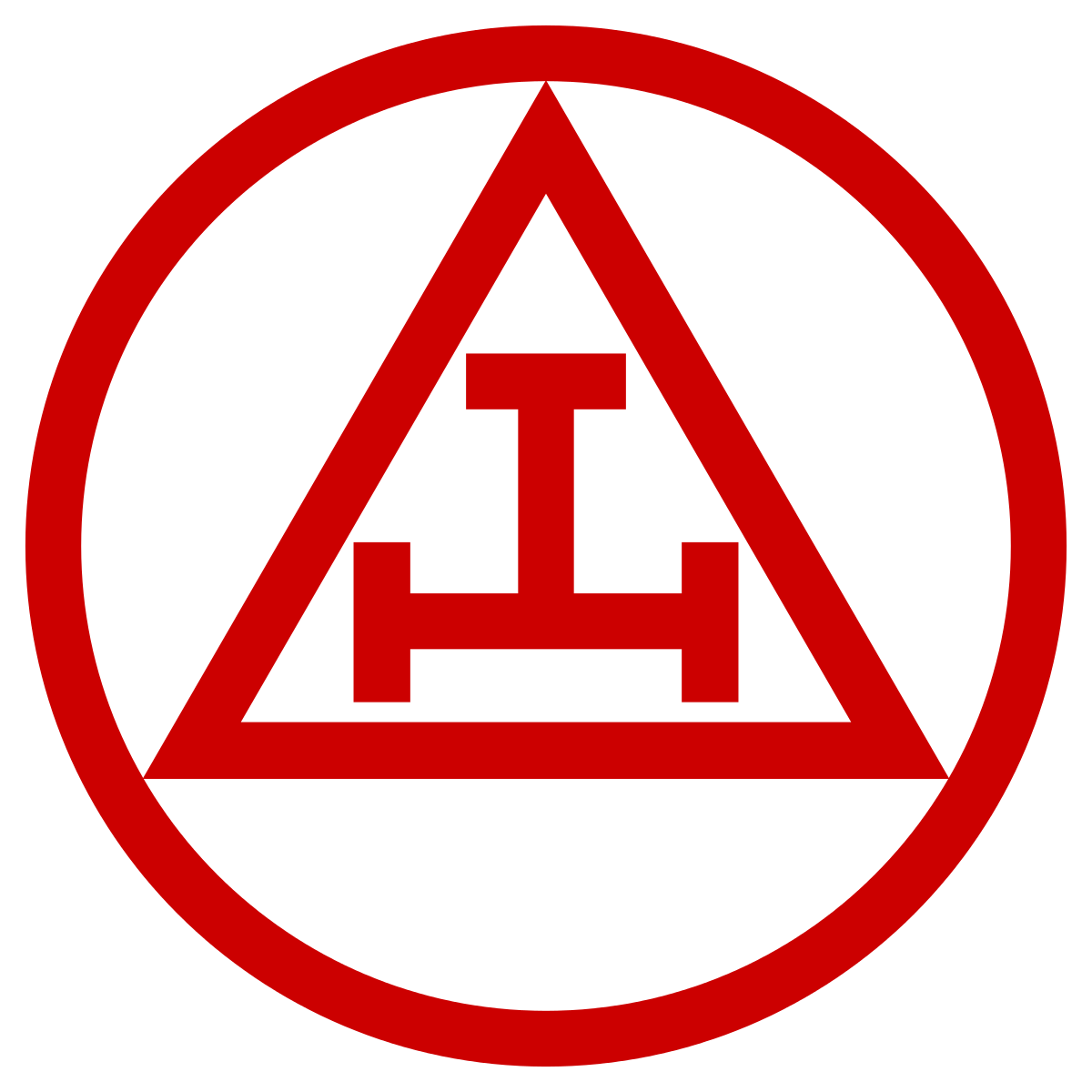
The encircled triangle of the royal Arch can furthermore be seen to unite the triangle of the material and spiritual worlds enclosed by the symbol of the Ouroubus, such that all is contained within the Omneity.
Investigations indicate that the Triple Tau at one point in the development of the degree may have represented a T over an H, standing for Templum Hieronysum, the Temple of Solomon.
Within the Qabalah itself, Tau represents the Light shining forth from Darkness and the Ultimate Origin as the final letter of the word of Creation; whilst Cheth is the essential Unity with God.
The Triple Tau in a T over H form can hence be seen to crystallise the meaning of the degree as Light leading to Unity with God.
The device of an inverted triangle within a larger apex up triangle, usually created by the arrangement of the candles in the Chapter acts a homologue of the Pythagorean tetractys.
The principal banners, namely those of the tribes of Reuben, Judah, Ephraim and Dan, represented by the Man, the Lion, the Ox and the Eagle arise from the vision of Ezekiel.
They can be qabalistically attributed to the four fundamental elements, Earth, Fire, Water & Air and are conjoined with the Triple Tau which may also be represented by Shin, the Hebrew letter denoting Spirit and in itself a pictogram containing three taus.
The twelve banners marshalled either side of the floorcloth can be seen to represent six pairs of pillars, supporting the arch of the vault; and inferring the whole of creation surrounding the centre as twelve is the number of the universe; again representative of the Pythagorean point within the circle.
The borders of the apron and sash of companions and principals reproduce alternating triangles which can be posited to further reiterate the union of the celestial and terrestrial triangles of the degree.
One can also see within the apron the triangular flap within the square of the apron, the Ternary within the Quaternary.
The Signs
The Signs of Penitence and Reverence very clearly refer to the destruction of the ego, to the removal of all self-absorbed thought and the quietening of the mind, and to listen to our heart. This is the true Mors Janua Vitae, that death is the gateway to life.
Still further, the allegorical descent into the vault by the Exaltee to receive the One Truth can be seen as isolation from the rest of mankind.
It can be thus considered by this analysis that the Royal Arch succinctly synthesises a dramatic allegory for the journey of Reintegration; that the symbolism in the degree mirrors that posited by Pythagorean sacred geometry and Gnostic theology and in one degree the whole of the journey is encompassed.
As Laurence Dermott wrote, the Royal Arch is the root, heart and marrow of Masonry; and the maxim that the Royal Arch is but the completion of the Master Mason’s degree, the eschatological goal of life is forcibly underlined.