their place in Royal Arch Masonry
Companions, you see before you at every convocation of the Chapter, five regularly constructed solids ranged before the ‘double cube’. Have you ever stopped to ask what and why they are there, even though they are scarcely mentioned in any of our meetings?
In fact the questions you should ask are two-fold:
“What are they?” and “Why are they placed so prominently within the Chapter furniture?”.
To answer these questions we must discover when they actually appeared for the first time and to do that we must look further back in time as researches indicate that they have been part of the Royal Arch furniture since the early 1700’s. So to make sense of their existence, I pose this question to you . . . . . What was Britain actually like in the 1700’s?
To answer my own question:
Britain was still predominantly rural like the continent of Europe. But agricultural output was at least twice that of any other European country. World trade was rising and Britain was benefitting from exporting more grain than it was importing. Its agriculture benefited development in general. Productivity and real wages were inching upwards. People’s lives were improving materially.
They were getting more in return for their labour. People thus had disposable income and could afford to buy manufactured items.
Until the 1720s, England’s population growth had been held in check by periodic harvest failures and by diseases such as influenza, smallpox, dysentery and typhus. At around five million in 1720, England’s population would be around nine million at the end of the century. London’s population in this period rose from around 700,000 to over one million.
France had more than three times England’s population, but Britain led in world commerce, ahead also of the Dutch Republic, which was economically progressive but had a fraction of Britain’s population.
With the rise in Britain’s commerce, London had become a busier place and had been attracting more people from England’s rural areas and from Scotland, Wales and Ireland. London also had migrants from Germany, Holland and France. London had become a great centre for the arts, the sciences and for fashion.
A new interest in variety and consumerism had developed. The idea that it was OK to find delight in buying things was taking hold. Christian abstinence was in decline. The Puritanism of Cromwell’s time was fading, and so too was adherence to Biblical admonitions regarding the accumulation, or lending of money. English men and women had begun wearing lighter and brighter clothing instead of heavy wool and linen. Meanwhile wrist watches were still inaccurate curiosities and people kept time by the ringing of church bells.
Britain produced quality woollen cloth, and it led the world in maritime trade, and trade with India made available new fabrics. In England a spirit of enterprise was growing.
With the new hustle and bustle of English life, people were accepting of higher taxation from which came much appreciated, centrally provisioned services.
These were times of increased literacy. Europe’s Enlightenment had reached maturity. Personal correspondence and other forms of writing were on the rise. Literate people gathered in groups interested in science or literature. A variety of learned journals were published. Book production had increased, and so too had newspaper distribution. In Scotland in 1700 around 45 percent the population could read, and by the end of the 1700s it would rise to 85 percent. England’s literacy rate in this same period is described as having risen from 45 to 63 percent.
These were times when fanaticism was more feared and intellect more respected. Restraint in the expression of passion had become more of a mark of a gentleman, and good manners had become more valued as a barrier against conflict.
Britain’s middle classes debated religion, science and politics in coffeehouses, clubs, salons and literary societies.
As had happened in the Dutch Republic, shifting religious beliefs and rising commerce was accompanied by a decline in demand for religious uniformity.
With Copernicus, Galileo and Newton a new optimism about the benefits of learning had arisen – in conflict with the old and common belief that the world was a mystery never to be fathomed by humanity.
The belief that the world functioned solely by God’s intervention was in decline, but many, including influential intellectuals who fully believed in the logic of the sciences also continued to believe fervently in God’s Divinity and scientifically observing perfect symmetry within God’s own natural creations and revealing Divine order within mathematics, conjectured that the seven liberal Arts and Sciences were in fact therefore Divine gifts from their Creator.
Many of these influential academics and natural philosophers were members of the ‘invisible college’ or Royal Society which had been founded in 1660 but they themselves found difficulties meeting together due to their strong but differing Religious views, so what was needed was an environment where they could discuss any matter, excepting Religion or Politics.
Now, let’s bear that in mind, but wind back in time a little to the mid 1600’s and look into the life and influence of a single individual:
Having married into significant wealth and having retired at the tender age of twenty five, in 1646 a philanthropist named Elias Ashmole recorded in his diary that he was “Made a Mason”.
Amongst other interests and dalliances, he was an Alchemist and he was well connected with other similarly minded individuals and it is speculated that through his network of contacts, that other academics and scientists decided that Masonic meetings indeed provided them with the ideal environment to meet and discuss ‘matters intellectual’ with like-minded individuals.
As membership of Masonic lodges grew after 1717, freemasonry seems to have been attractive to Fellows of the Royal Society. Several were closely involved in promoting new Lodges and developing the constitutional basis of the new Grand Lodge. Early Lodges were sometimes a forum for lectures on scientific subjects. John Desaguliers himself, an occasional assistant to, and important publicist for Isaac Newton’s scientific ideas, was also a leading and influential Freemason and became Grand Master shortly after the time of the Union in fact writing most of the Masonic ritual from which out Modern ritual is drawn.
By the end of the 1700s, particularly during the Presidency of Sir Joseph Banks, himself a Freemason, membership of the Royal Society had become a mix of working scientists and wealthy amateurs who were potential patrons and could help finance scientific research at a time before the government considered doing so itself.
Several of these patrons were also Freemasons and would have met with scientists both at meetings of the Royal Society and in Lodges.
What an AMAZING time it must have been to be a Freemason?
As the professionalisation of science developed in the nineteenth century, Fellows began to be elected solely on the merit of their scientific work. New types of science developed and science education expanded with the growth of university science degrees and medical schools.
Freemasonry attracted these scientist Fellows often in the growing number of new Lodges whose membership was drawn from particular universities, hospitals or other specialist groups.
. . .
OK, so let’s wind back once again and look at the formation of Freemasonry “as we know it” and in particular at the formation of the Holy Royal Arch:
FREEMASONRY
Before the 1700’s, as you are fully aware, there were two separate factions within the Craft, constantly at odds with one another; the Antients and the Moderns and it’s not likely to be news to any of you that they amalgamated under the auspices of the United Grand Lodge of England in 1717, yet following that date, relatively little is known as minutes of the early meetings have not survived. However subsequent minutes from 1723 record that Four Lodges met at the Goose and Gridiron in St. Paul’s. The original constitutions of Freemasonry were written by a Presbyterian clergyman named James Anderson and this work was in fact reprinted by Benjamin Franklin in Philadelphia in 1734.
The following section is slightly contentious, but I believe there is sufficient evidence to back up what is my conjecture. With that said, I continue:
In simple terms, in amalgamating the Antients and Moderns, a certain amount of ritual from the Antients ceremony became superfluous and was omitted from the ceremony.
When Freemasons Initiated into Lodges under the jurisdiction of UGLE visited other Districts, they themselves discovered that their knowledge was incomplete and not being able to demonstrate themselves knowledgeable in the additional ritual were barred from the meetings.
A movement was thus set up to form an Order in which might be conferred the additional ritual and from this grew the full and beautiful ritual we enjoy in the Holy Royal Arch ceremonies we know today. This is the reason Chapter is considered the completion of Craft Freemasonry, simply put “Because it actually is!”, whereas other orders although valuable, interesting and in some cases ‘beautiful’ are quite separate to, and distinct from Craft Freemasonry. It is also the reason why every Chapter has to be ‘attached’ to a Craft Lodge, as each new Chapter to be consecrated takes it rise from a Craft Lodge wishing to confer the ‘additional ritual’ upon Master Masons to complete their Third Degree.
Now we have a Masonic Order being created by necessity and a number of influential academics in charge of the laying down constitutions and documenting the ritual.
It is therefore little wonder that these philosophers, scientists, mathematicians and astronomers alike, who all believed that findings within their own science is a Divine gift wanted to influence the new order with aspects of their own specialism.
The geometricians and mathematicians bequeathed the Holy Royal Arch the five Platonic Solids truly believing them to be Divine creations, and divine creations they are indeed:
(. . . Here comes the science bit!)
These solids Companions are truly perfect. They are, each of them, regular convex polyhedra, constructed from regular polygonal faces with the same number of faces meeting at each vertex.
Geometricians have studied the mathematical beauty and symmetry of the Platonic solids for thousands of years. They are named for the ancient Greek philosopher Plato who theorized in his dialogue, the Timaeus, that the classical elements themselves; earth, water, air, fire and ether, were composed of these regular solids.
Briefly, the solids are;
- the Tetrahedron with four triangular faces,
- the Cube with six square faces,
- the Octahedron with eight triangular faces,
- the Dodecahedron with twelve pentagonal faces and
- the Icosahedron with twenty triangular faces.
The classical opinion is that only five convex regular polyhedra are possible and this postulation has now been mathematically proven and topological proofs are available on request.
The tetrahedron, cube, and octahedron all occur naturally in crystalline structures and thus would have been observed by cleaving crystals or more recently viewing them under the microscope confirming their place as Divinely created structures.
The Dodecahedron and Icosahedron do not occur in crystalline form but many viruses such as the Herpes virus is in the form of a regular Icosahedron, but unfortunately, I don’t have a sample of this with me!
Several ‘Platonic Hydrocarbons’ have been synthesised in laboratories, including Tetrahedrane, Cubane & Dodecahedrane, but the Dodecahedron does not occur naturally, so not being observable to our forefathers, its existence was purely the result of a sequence of mathematical proofs and these too are available after the lecture (at a small cost).
So having learned the valuable lessons of the first, second and third degrees, the value of life itself, the value of education and the importance of having made a positive difference on this mortal coil before you are summoned by your maker, the creators of the Holy Royal Arch sought to confer to all future Exultees the enlightenment of the divine creation of the objects you now see before you. And I hope you will further your own investigations and share your knowledge with those who follow behind you.
There follow three proofs: Geometric, Topological and Biblical. The Biblical proof included to indicate how closely were inter-woven Science and Religion in the period up to and including the Eighteenth Century.
Geometric proof
The following geometric argument is very similar to the one given by Euclid in the Elements:
- 1. Each vertex of the solid must be a vertex for at least three faces.
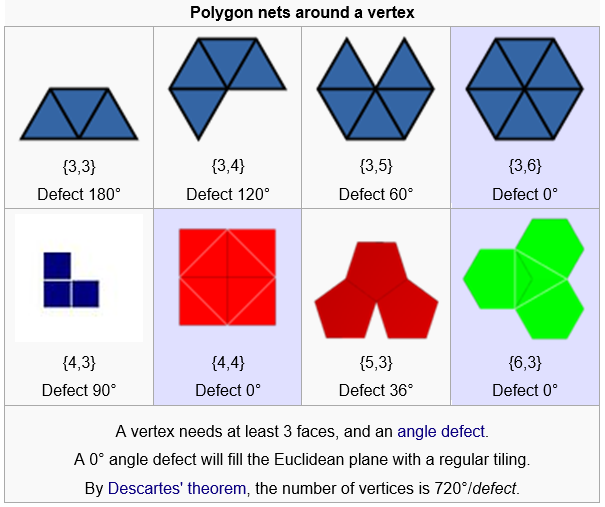
- 2. At each vertex of the solid, the total, among the adjacent faces, of the angles between their respective adjacent sides must be less than 360°. The amount less than 360° is called an angle defect.
- 3. The angles at all vertices of all faces of a Platonic solid are identical: each vertex of each face must contribute less than 360°/3 = 120°.
- 4. Regular polygons of six or more sides have only angles of 120° or more, so the common face must be the triangle, square, or pentagon. For these different shapes of faces the following holds:
- • Triangular faces: Each vertex of a regular triangle is 60°, so a shape may have 3, 4, or 5 triangles meeting at a vertex; these are the tetrahedron, octahedron, and icosahedron respectively.
- • Square faces: Each vertex of a square is 90°, so there is only one arrangement possible with three faces at a vertex, the cube.
- • Pentagonal faces: Each vertex is 108°; again, only one arrangement of three faces at a vertex is possible, the dodecahedron.
- Altogether this makes 5 possible Platonic solids.
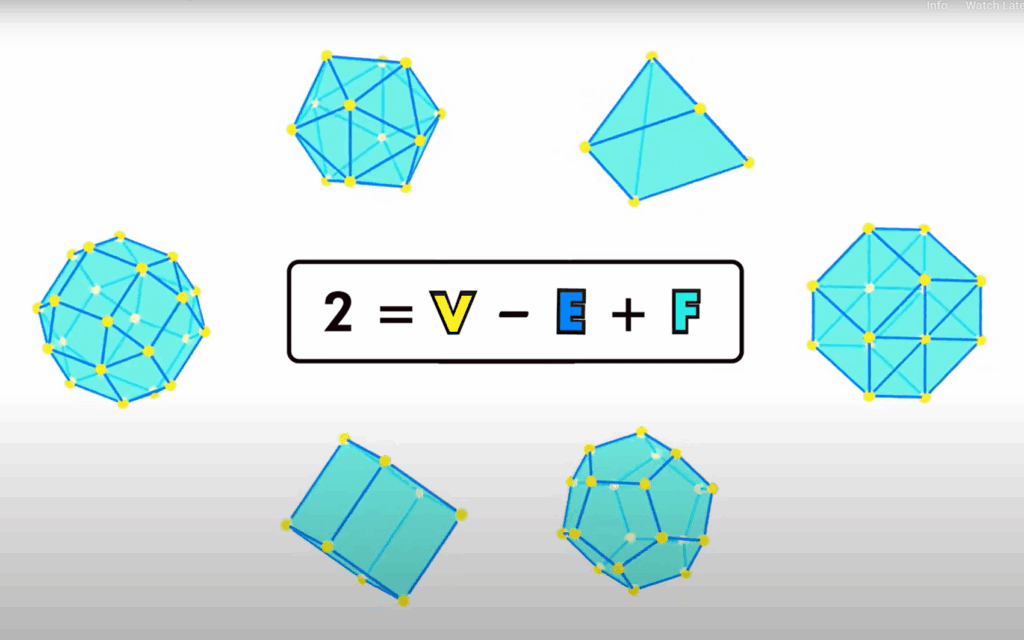
NB – Long before Euler, in 1537, Francesco Maurolico stated the same formula for the five Platonic solids (see Friedman). Another version of the formula dates over 100 years earlier than Euler, to Descartes in 1630. Descartes gives a discrete form of the Gauss-Bonnet theorem, stating that the sum of the face angles of a polyhedron is , from which he infers that the number of plane angles is 2F + 2V – 4.
Topological proof
A purely topological proof can be made using only combinatorial information about the solids.
The key is Euler’s observation that:

and the fact that:

where p stands for the number of edges of each face and q for the number of edges meeting at each vertex.
Combining these equations one obtains the equation:
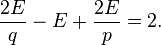
Simple algebraic manipulation then gives:
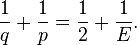
Since ‘E‘ is strictly positive we must have:

biblical Proof
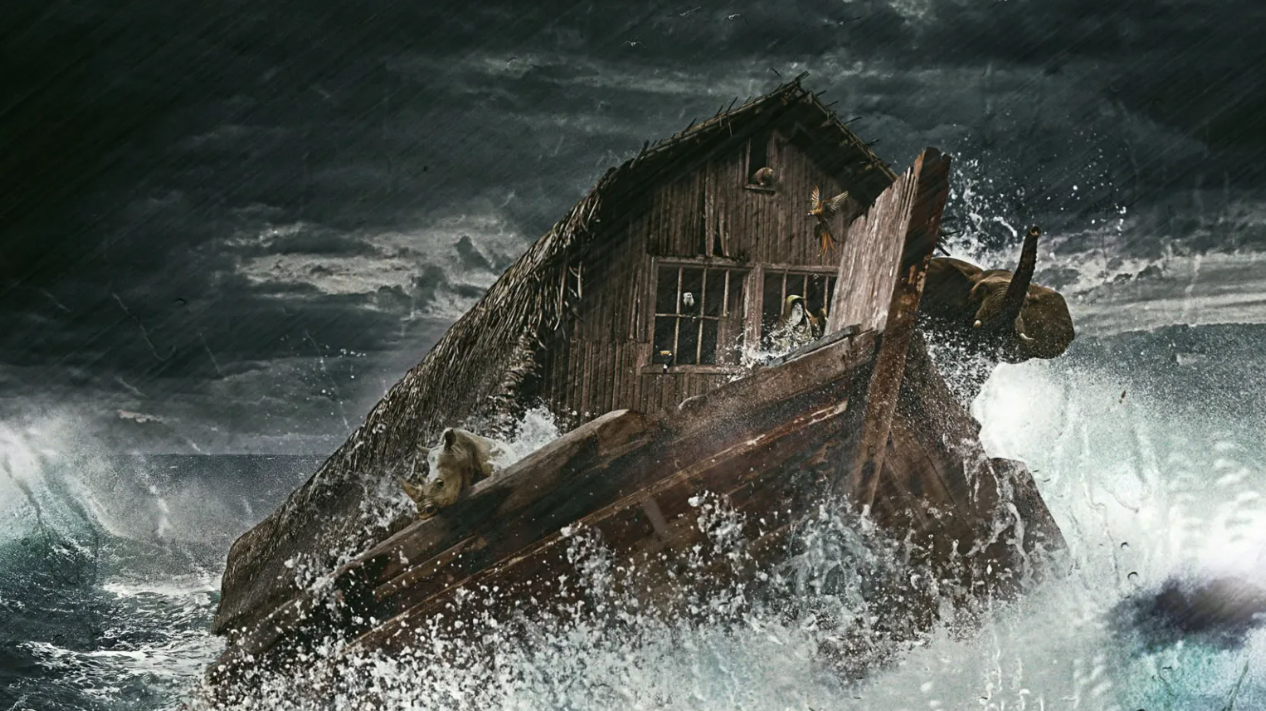
Euler’s Formula, Proof 14: “Noah’s Ark”
Define a height function on the surface of the polyhedron as follows: Choose arbitrary heights for each vertex. In each edge, choose a height for one interior point greater than that of the two endpoints, and interpolate the remainder of the edge linearly between the chosen point and the endpoints. In each face, choose a height for one interior point, greater than all heights on its boundary; interpolate the heights in the rest of the face linearly on line segments from the chosen point to the boundary. The result is a continuous function with critical points: local minima at the vertices, saddles at the chosen points of edges, and local maxima at chosen points of faces.
Now view the surface as an initially bone dry earth on which there is about to fall a deluge which ultimately covers the highest peak. We count the number of lakes and connected land masses formed and destroyed in this rainstorm to obtain the result.
For each local minimum there will be one lake formed. For each saddle there will either be two lakes joined or a single lake doubling back on itself and disconnecting one land mass from another (let and denote the number of times these events happen respectively). For each peak a land mass will be eliminated. Initially there is one land mass, and in the final sitation there is one global lake. Thus we have and . Combining these two equations with the fact that yields the result.
One can either view the rainfall as (unnaturally) causing the global water levels to always be at the same height, so that two lakes reach a saddle at the same time; or one can take a more realistic viewpoint and say that the rainfall may vary arbitrarily over the globe, but when one lake reaches a saddle the water will spill over it (and the lake will not rise) until the lake on the other side of the saddle reaches the same height.
This proof is close to self-dual, the biggest asymmetry being in the definition of the height function. As usual, the Jordan curve theorem is involved, in the fact that a lake doubling back on itself creates an island. The principle of classifying the singular points (peaks, saddles, and valleys) for a height function defined on a surface is the main idea behind Morse theory, but this proof dates back much earlier than Morse, to an 1863 publication of Möbius.