WHEN trying to picture the condition of English freemasonry at the introduction of the R.A. it is necessary to remember that speculative masonry ‑ recorded speculative masonry ‑ was then about a hundred years old. The present writer’s Freemasons’ Guide and Compendium sets the scene at some length, and all that need now be done is to give the reader enough background for him to understand how the conditions of Craft masonry in the early eighteenth century allowed of the grafting on of such an extremely important addition as the Royal Arch.
English Craft masonry had apparently developed many years prior to 1621, possibly from operative lodges, but if its true origin was in those lodges, then the path to speculative masonry led from them to and through the London Company of Freemasons. In the middle of the seventeenth century there were many operative lodges in Scotland, and some of these in the next century played their part in the founding of the Scottish Grand Lodge, although apparently their speculative masonry had largely, and perhaps almost wholly, reached them from England. Conditions in the two countries were vastly different, but it is safe to say that recorded history does not certainly reveal any story of natural development between any operative lodges whatsoever and speculative freemasonry. In the early seventeenth century there must have been quite a few English speculative Craft lodges, and by the end of that century there were probably many, but we know hardly anything of their ceremonies, although we have reason to assume that these were simple, probably bare, and contained little ‑ but definitely, an important something‑of an esoteric nature; whatever it was, it attracted the attention of a few learned, classically educated men ‑ many of an alchemical turn of mind ‑ who undoubtedly left their impress upon the ritual. So, at any rate, it seems to the writer, who, the more he learns of the symbolism of the old alchemists, realizes increasingly that much of the classical allusion and symbolism which entered freemasonry by the middle of the eighteenth century must have been contributed by men who, in professing to study the method of transmuting base metals into gold, were actually speculatives of a high order men of fine character and mostly of profound religious conviction.
Before 1717 we have only the sketchy records of lodges at that time in existence, but in that year four time‑immemorial lodges came together to form the Premier Grand Lodge, the first Grand Lodge in the world. These four lodges “thought fit to cement under a Grand Master as the Center of Union and Harmony,” but much more than that may have been in the minds of the founders. This first Grand Lodge created a Masonic centre with a Grand Master, Quarterly Communications, Annual Assembly and Feast, and provided Constitutions that would replace the Old Charges. The first‑known of these Old Charges, going back to about 1380, had been designed for “different days, different men and wholly different conditions.” The first Constitutions, 1723, written and compiled by a Scot, Dr James Anderson, were issued “with a certain measure of Grand Lodge authority.” The title came probably from the practice of the London Masons Company (a gild), who gave the name to their copies of the Old Charges. It is believed that Anderson had the help of John Theophilus Desaguliers, the third Grand Master, and, possibly because of this, Grand Lodge, which was critical of Anderson’s first effort, eventually permitted the publication of the rewritten manuscript, which was in print by January 1723. These Constitutions, apart from being the original laws governing the Masonic Order, are of particular interest to Royal Arch masons, inasmuch as they include the charge “Concerning God and Religion,” already discussed, which was at marked variance with much of the contents of the Old Charges. “The next thing that I shall remember you of is to avoid Politics and Religion,” says Anderson. It is highly likely that general experience had already shown the desirability of uniting freemasons on “a platform that would divide them the least.” “Our religion,” says Anderson, “is the law of Nature and to love God above all things and our Neighbour as ourself; this is the true, primitive, catholic and universal Religion agreed to be so in all Times and Ages.” There is much point in quoting Anderson in this place; he could not know that the Christian element which he, with the approval of Grand Lodge, was trying (far from successfully) to eliminate would surely be restored by a later generation, not to the First and Second Degrees – probably the only Masonic ceremonies known to him ‑ not to a Third Degree then developing in a few lodges, but to what the freemasons of the second half of the century would call a “fourth” degree the Royal Arch ‑ that would arise within a few decades.
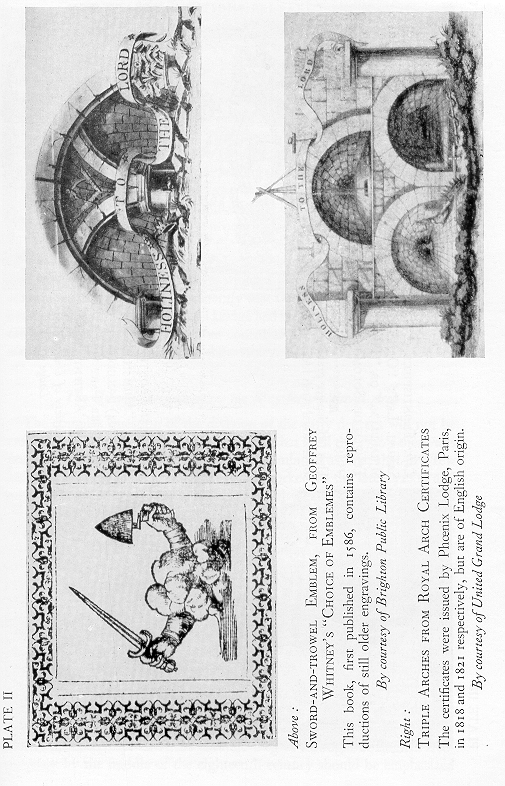
The new Grand Lodge, by assuming authority and publishing its Constitutions, was not necessarily assuring itself of the allegiance of the whole Masonic body. While it is difficult to get at the facts, it has become obvious that many lodges and many freemasons remained outside its jurisdiction, a point easy to understand when the comparative lack of communication and transport is borne in mind. There must have been country lodges that did not even hear‑or, at any rate, hear much‑of the new Grand Lodge for many years, and there must have been others that were resentful and critical of any Masonic body presuming to affect superiority and the right to issue orders and instructions to others. This is a most significant fact, and in it may be part of the explanation of much of the opposition to which the new Grand Lodge was subjected, and which, only a generation later, was a factor leading to the founding of a rival Grand Lodge. We know that in some quarters the Premier Grand Lodge was “not only laughed at” but brought under suspicion, and it is said (we must admit the absence of any definite proof of the statement) that only sixteen years elapsed between the issue of the first Constitutions and the beginning of a movement that ultimately blossomed into the Antients’ Grand Lodge. Sixteen years was none too long a period in those days of poor communications for even a consistently wise Grand Lodge to have placated its opponents. But the first Grand Lodge had its share of failings, and there can be no doubt that its own actions contributed to the serious trouble that was to assail it by the middle of the century.
The Hiramic Degree paves the Tray for the Royal Arch
The complex question of the division of the early degrees will not be entered into here. It will be simply assumed that until the 1720s there was probably but one degree or two degrees combined as one; that in a few lodges the Hiramic Degree began to be worked in the late 1720’s; and that by about the middle of the century the English lodges were, in general, working a system of three degrees, of which almost invariably the first and second were conferred on the one occasion. This statement, we know, can be debated, but in general it represents the likely truth, always remembering, however, the considerable differences in custom and ceremonial among the early lodges. There is evidence that by 1750 or thereabouts the three‑degree system was established in England, though in most of the lodges under the Premier Grand Lodge the Fellow Craft was still qualified to undertake any office whatsoever, and that it was not every Fellow Craft who took the trouble to proceed to the Third Degree. The rise in 1739‑51 of the rival Grand Lodge‑the Antients’ ‑ whose ceremonies were closely watched and sometimes adopted by their opponents, helped to bring about a condition in which the “skilled” and qualified mason was never less than the third‑degree mason ‑ the Master Mason.
The general adoption of the Hiramic Degree throughout English freemasonry by the middle of the eighteenth century should be emphasized because it means much to the R.A. mason. Failing its introduction, the R.A. might never have become a part of the Masonic Order. Let it be remembered that the mason of the early lodges was in general a religious and relatively simple soul. The story unfolded by the Hiramic legend prepared his mind for yet another story, this one serving to make good two things that were absent from the earlier degrees. The three‑degree system, ending in what may appear to be disappointment and anti-climax, prepared the way for the introduction of a degree which, new or otherwise, was accepted particularly by the opponents of the Premier Grand Lodge as part of an ancient system. It is a point of the greatest significance that it was these opponents that adopted and developed not only the R.A. ceremonial but also the Craft Installation ceremony which, in its sequel, became a bridge from the Craft lodge to the chapter, and still serves in that way in some jurisdictions overseas.
The author’s earlier work mentions the considerable public interest aroused by freemasonry in the 1720’s. This, in particular, led to the publication of irregular prints, the so‑called Exposures,’ notably Prichard’s Masonry Dissected (1730), which purported to give the ritual and secrets of freemasonry and had a most amazing sale in England and in all English speaking countries, being reprinted many scores of times during the eighteenth century. Prichard’s book had a lasting effect and a very complex one. It was freely bought by masons, and must have influenced lodge ceremonial in a day when the ritual was handed down by word of mouth without the help of printed aides‑memoire; thus it played into the hands of impostors who could set themselves up to Initiate’ credulous people on payment of a few shillings. There is no doubt that its publication frightened the Grand Lodge into making a grave and unfortunate decision (the transposition of the means of recognition in the First and Second Degrees), a decision which brought about serious trouble. In the course of that trouble arose the rival Grand Lodge ‑ the Antients’ ‑ a development which was the greatest of all factors in the introduction and rise of the Royal Arch.
How did the Royal Arch come to be Accepted?
Whether the ‘New’ degree was entirely an innovation or whether it was an amplification of time‑immemorial elements, however and wherever it arose, some explanation is needed of how it came to be so enthusiastically adopted by the Antients,’ who prided themselves on working a truly ancient ritual, and who were quite convinced that the innovators were their opponents.
How came these conservatively minded Brethren to accept a degree which, however it was presented, must, one would suppose, come as at least partly an innovation? Of course, the degree could not possibly have been presented to them as merely an attractive ceremonial. It could have come only in the guise of a truly ancient ceremony, which they accepted as a true part of the Masonic scheme. Those Moderns’ too who unofficially welcomed it must have regarded it in the same light.
As the author sees it, only one course was possible. In the days between 1717 and the rise of the Committee that ultimately flowered into the ‘Antients’ Grand Lodge there must have been, as already said, quite a number of lodges that did not recognize the Premier Grand Lodge, lodges possibly several days’ journey by horse or coach from London, lodges which in some unknown way had arisen here and there and which, while probably conforming in essentials one with another, almost certainly practised many variations of ceremonial. Such lodges could and did please themselves. If to them were introduced an addition, a detail, a ceremony, that struck them as having merit and in which they saw (rightly or wrongly) evidence of what they would regard as the original pattern of freemasonry, then those additions, details, and ceremonies they would adopt. There was nobody either to criticize or obstruct their intention.
We can easily picture the attractive ceremony of the R.A. coming to these lodges. It would offer itself as a hitherto neglected rite; it would follow in the Christian tradition to which its members were well accustomed; and it would bring to them that which they had learned had been lost. Many of the lodges which ultimately found themselves under the Antients’ banner must have been lodges of that order‑more or less detached, independent or semi‑independent, and composed of simpleminded, religious men none too critical of their ritual so long as it gave the impression of time‑immemorial usage. One lodge would learn from another, and very quickly, too, because there was something about the Royal Arch that rapidly assured its popularity, and by the time the Antients’ Grand Lodge was founded there would be, all ready for general adoption, a ceremony, even a fully fledged degree, highly attractive to the mason of that day. And if, as we may well conclude, any correspondence between the Third Degree and the Royal Arch was in places far closer than now is the case, all the better in the eyes of the Brethren of the day.