IT will already have been realized that the Installation ceremonies are not of ancient date, being much later than the corresponding Craft ceremonies and, in their present form, not earlier than 1835.
Until the Union there was much diversity of custom with regard to the Installation of the Principals; in many chapters the elected Principals just ‘assumed the chair’ without ceremony, and when, in later years, the time arrived when they were expected to be esoterically installed it became necessary for them to attend other chapters where experienced Companions could properly install them and, in addition, teach them how to install their successors.
In the first Grand Chapter in 1776 Captain Bottomley “installed” the M.E.Z., and other officers were “appointed”; the J. and H. were “invested” and received their charges from the M.E.Z., but the word “installed” did not carry all the significance it carries to‑day. In that same year Companions Heseltine, Brookes, and Allen are distinguished as P.Z. in a list of Companions present. In Wakefield, where the designations Z., H., and J. began to appear after 1790, there are no records of Installations about that time.
It was quite usual for only the First Principal to be installed and for him then to invest the other officers. (Bear in mind that “to install” is to put a Companion into his chair of honour; “to invest” him is merely to clothe him with the insignia of his office, although it must be admitted’ that, in Scottish phraseology, all officers are “installed,” nominally if not actually.) Thus, in the Chapter of Knowledge, No. 92, Middleton, Lancs, constituted Sunday, May io, 1807, the First Principal only was placed in his chair with certain rites. In a relatively few cases in the old chapters all Three Principals were separately installed, and it is possible that here and there the ceremonies were of a (probably slight) esoteric character. As an example, in the Chapter of St James in 1800 all Three Principals were separately installed; then Past Principals of the different chapters were severally introduced, after which the M.E.Z. requested that the Steward (then a more important officer than he is to‑day) be informed that chapter was opened, the Steward then duly introducing the Companions. It is on record that in the first Grand Chapter, in May 1810, on the occasion of the Installation of the Duke of Sussex as M.E.Z., each of the Three Principals was installed by means of an esoteric ceremony.
The ecclesiastical word “inducted” will be noted in some old by‑laws and minutes. The literal meaning of “to induct” is “to lead.” The South Australian Chapter, Adelaide, had a by‑law in the year 1854 directing that officers “so elected and appointed shall be duly installed, invested, and inducted in ancient form.” Many similar by‑laws are known.
Installation following the Union
Obviously, following the Union, much thought had to be given to the ceremonies of Royal Arch masonry and to the qualification of Companions for office. It must not be assumed, though, that the ceremony of Installation necessarily in the years immediately following the Union included the conferment of special secrets. Serious students are convinced that, at the Royal Arch Union of 1817, the Antients’ in general had no particular secrets restricted to the principal chairs and that in Ireland the Principals had no esoteric ceremony until as late as 1895. What was true of the Antients’ in general must have been equally true of the Moderns,’ although it has been shown that a few chapters, one of them as early as 1807, another in 1810, had a definitely esoteric ceremony.
Supreme Grand Chapter appointed in May 1818 a special committee to install with proper ceremony such Present and Past Principals as had not been already so installed, and in 1822 this committee was enlarged to include all the installed P.Z.’s of London chapters. A similar committee was functioning in 1824, and its duties were not confined merely to London.
That at the time of the Union there had come a more general recognition of the importance of a true Installation ceremony may be presumed from the fact that in the Chapter of Friendship, London, which had just been founded, a Companion was in the year 1824, “in ancient form and with the accustomed rites, duly installed in the Chair of the Third Principal.” In St George’s Chapter, No. 140, esoteric Installation was adopted apparently no earlier than 1838 (working a drastically revised ceremony as compared with that of 1824), which is extraordinary in view of the fact that this chapter had long observed the custom by which the Principals alone opened the chapter, the Companions being afterwards admitted “and placed in their respective station”; this practice held good until 1902.
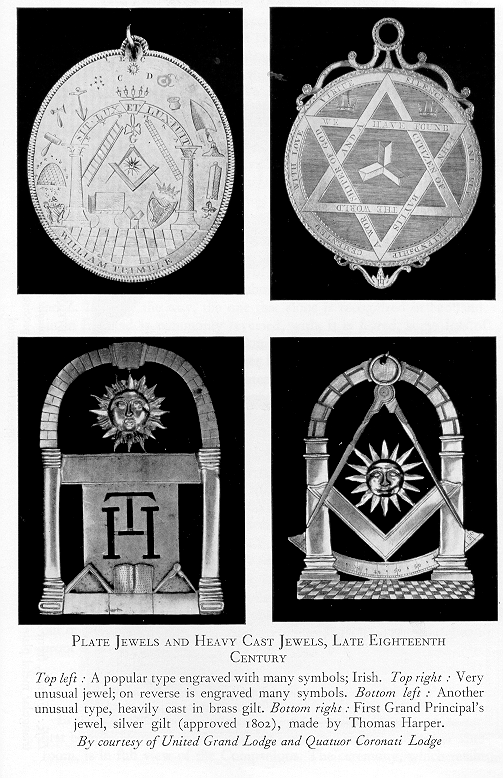
The alteration in the Installation ceremonies following the Union and, later, the revisions of 1835 led to a general practice of installing Companions “out of their Chapters.” W. H. Rylands’s history of St James’s Chapter explains that in 1839 the Principal Officers of the Cheltenham Chapter and of the Oxford Chapter were installed in the St James’s Chapter. An unusual case is that of March 1858, when Robert Hamilton, M.D., the J. of Chapter 299, Jamaica, who had left the island before his Installation, was introduced into the St James’s Chapter and installed “Joshua of the Order.” In April 1870 a dispensation to install James Percy Leith into the First Chair of the Chapter of St George, No. 549, Bombay, was read in St James’s Chapter, and the Companion was “then duly installed into the Third, Second and First Principals’ Chairs.” The Chapter of Fortitude, No. 102, Leicester, met in October 1821 for the special purpose of installing Companions of other chapters; at this meeting the First Principal of the Royal Brunswick Chapter of Paradise, Sheffield, was installed as J., H., and Z.; the Second Principal as J. and H.; and the Third as J. The chapter from which the Three Principals came is still attached to the lodge, No. 296, that bears its old name, but the chapter itself is now known as the Chapter of Loyalty.
The sequence of Installations above given should be noted ‑ J., H., and Z. It is, by the way, the one that alone is recognized in Scotland, but in England is commonly reversed, with, it is feared, some loss of continuity and sense of progression.
After the Installation of the Three Principals comes first the investiture of the Scribe E. Still, as in the eighteenth century Craft lodges where the custom arose, he takes precedence of the Treasurer, although in the Craft itself the Secretary became junior to the Treasurer quite early in the nineteenth century. Another reminder of Craft practice is the placing of the Scribe N. in the South to control admissions, just as the junior Warden in the South is responsible for all admissions.
Following the heavy revision of the ritual in the 1830s recourse was had to the earlier method of bringing into existence special Chapters of Promulgation and Instruction in which the Principals could be installed and the new ceremonies taught. Thus, when a chapter of this kind was held by the Provincial Grand Chapter in July 1837, at Plymouth, several Prominent Royal Arch masons of the city were installed. This Especial Chapter must have been one of many.
To‑day’s Grand Chapter Regulations permit a Principal to be installed out of his chapter at the written request of the chapter and on producing proof of election.
Installation in the Bristol Chapters
In the Bristol chapters the actual chairing of the Principals, who have first been obligated, invested, and entrusted in a separate chapel or anteroom, is in full view of the Companions. The ceremony, which retains much of the atmosphere of early nineteenth‑century working, opens with the Three Principals Elect standing between the pillars (these are fullsize, as in the old Craft lodges) and being addressed by the installing Z. They are then obligated “as regards the government of the Chapter,” and all First Principals then withdraw to the chapel, where the Z. Elect, who has accompanied them, takes his second obligation, is anointed, invested, a crown is placed upon him, and he is given his sceptre and then entrusted. The Second Principal Elect is then admitted, obligated, invested, crowned, and entrusted. Next the Third Principal Elect is admitted and invested, a rite based upon Leviticus viii, 5‑9, is then performed, this including particularly his investiture with the jewelled breastplate and mitre and crown, following which he is entrusted. For the actual Installation all now return to the chapter, where the other Companions await them, and the Three Principals are duly placed in their chairs by the installing Z., the appointment and investiture of officers then following.
The Office of Principal
The Three Principals when in chapter are to be regarded conjointly and each severally as the Master (see p. 125). As to their qualifications, the Regulations of Grand Chapter require the Third Principal to have been installed as Master of a Craft lodge (this dates back to May 1826) and to have served one year as a Scribe or as a Principal or Assistant Sojourner (overseas such service in office is not insisted on). The Second Principal (as from August 1826) must be an Installed Third Principal, and the First Principal an Installed Second, and in each case there must be a full period of one year since his election to the junior chair. A First Principal may not serve for more than three years in succession; a Second and Third not more than two years in succession, other than by dispensation. A companion may not serve as First Principal in two separate chapters at the same time, except by dispensation.
On the death of any Principal, either before or after an Installation, another is to be elected by ballot and then installed. In the absence of the First Principal, the Immediate Past or Senior Past First Principal of the chapter may, in that order, act in his stead; failing either, then a Senior Past First Principal among the subscribing members may serve, failing whom any qualified Companion may be invited by the First (or acting) Principal to do his work. Principals temporarily absent may, in some circumstances, request qualified Companions to occupy chairs and exalt Companions “as if they were themselves present.” The First Principal of a chapter has the prefix “Most Excellent” attached to the title of his office, but not to his name, but all Principals, present and past, are “Excellent Companions,”.
Passing the Z. Chairs
Just as on occasion a Brother was ‘passed through the chair’ of a Craft lodge (as explained in a later section), so, too, there were occasions when a Companion would be given the dignity or status of a Principal by being ‘passed through a chair,’ in which regard the minutes of the first Grand Chapter contain many surprising instances. At the festival meeting, January 9, 1778, Brother Ross was elected Principal, “and was invested accordingly; but offering many satisfactory reasons for not continuing in that high office the Companions proceeded to a second ballot,” at which the Z. of the preceding year was re‑elected. It was then moved “that the honours of P.Z. be given to Companion Ross for his Zeal and Attachment to this sublime Order and that a Medal be ‘presented.” At the next meeting “a gold medal of the Order in the rank of P. Z.” was presented to two dukes, one Italian and the other English, who had been exalted that very evening, without apparently even the semblance of an Installation. In the following January the rank of P.Z. was conferred by the same subterfuge on another Companion. In January 1783 there was exalted in Grand Chapter the Rev. Waring Willett of Oxford, who was immediately invested Chaplain, the first holder of the office; at this same meeting the rank of P. Z. was again conferred, but the “Brother” so honoured declined the P.Z. jewel “as the Chapter had not benefited by his passing the Chair so suddenly.”
Now all these Brethren had been dignified with a title, but had not passed, even temporarily, through the actual chair of a chapter, but we come to a rather different and even diverting incident in June 1801, when, in St James’s Chapter, two members who had been appointed Provincial Superintendents but were not Past Principals were passed through the Z. chair at a special Chapter of Emergency “in order to qualify them for discharging the functions of their exalted situations.” Companion A. was elected to the H. chair and Companion W. to the J. chair (and we presume installed). Then Companion A. was proposed as Z. and Companion W. as H. They were installed, whereupon Companion A. resigned “his new situation,” and Companion W. was elected Z. to succeed him and installed. This was not the end of the proceedings, for at this same meeting Companion H. passed “the several chairs by regular election and installation,” and, on his resignation as Z., the former M.E.Z. (Companion Wright, the real M.E.Z.) was re‑elected as Z. Other Installations and resignations took place, altogether eleven Installations on the one occasion, as fully described by W. Harry Rylands in his history of the St James’s Chapter, more properly the Chapter of St James.
A hint as to the possibility of there having existed at one time something in the nature of a “P.Z. Degree” comes from the knowledge that one or two chapters had a custom of making an esoteric communication to the First Principal on his leaving the chair at the end of his period of office, as, according to J. R. Rylands, was the case in the Wakefield Chapter.