THE triangle, especially the equilateral triangle (see illustration), is one of the most ancient symbols in the world. To the Christian it symbolizes the Trinity, all its three sides being equal. So sacred has the emblem always been regarded that, says the ritual, an oath given on it has never been known to be violated. The three lines in conjunction represent the Sacred Word, the essence of the Deity. In early days such a triangle was conspicuous in Craft lodges, and within it was the V.S.L., an arrangement still to be seen, it is thought, in the Bristol working. It has already been explained that the triangle containing the Yod (the first letter of the sacred name) represents the power and efficiency of the Almighty. The point within a triangle or the point within a circle represents the Supreme Being, the infinite yet unknowable, the all‑pervading yet unknown. Similar emblems were familiar to the old alchemists. A German work (1718) on elementary chemistry (and alchemy was the forerunner of true chemistry) illustrates a triangle with a human head or skull occupying its lower part, a device peculiarly sacred to the alchemist and carrying with it the idea of the Supreme Being. Sometimes there was an “all‑seeing eye” within the triangle, the meaning being much the same but including the idea of an omnipresent God.
The Chaplain of a Craft lodge has the triangle in his jewel. The Grand Master’s jewel, the open compasses, includes a gold plate on which is the “all‑seeing eye” within the triangle. The circle within a triangle or trine compass (Chaucer’s term) is one of the most venerable of symbols (“that of trine compass Lord and Bide is”), and carried with it the meaning of the coequality and coeternity of the Three Persons in the Trinity.
The triangle is often called the delta, a name derived from the shape of an island formed by alluvial deposits between the two mouths of the Nile and now a common name for a triangular piece of land formed by the diverging mouths of any river. In some additional degrees the delta is the luminous triangle or brilliant delta and encloses the Tetragrammaton.
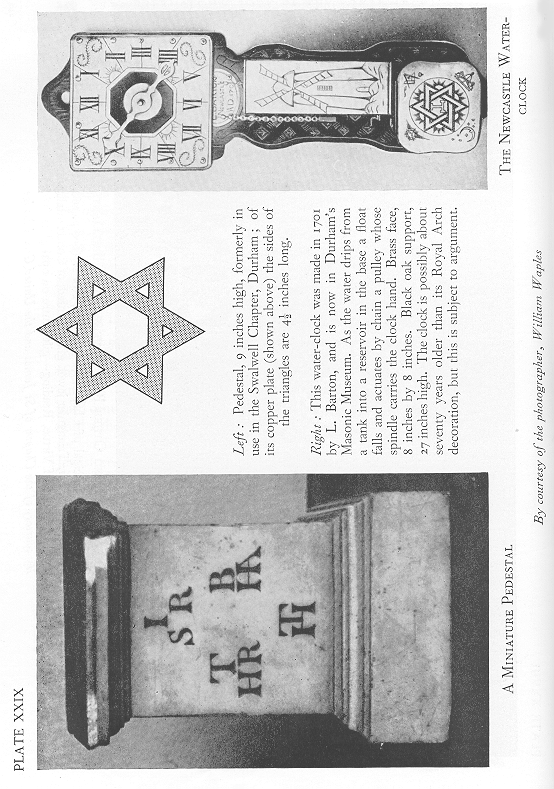
To the alchemist the triangle was a symbol leaving many meanings. Standing on its point it meant water; on its base it meant fire; standing on its point and divided horizontally it meant earth; on its base and divided horizontally it meant air. To many alchemists the Philosopher’s Stone was “triangular in essence,” and the statement is made that in one or more old Masonic rituals the stone is given as being of triangular form. Dunckerley, writing to the Grand Secretary, William White, says, “I greet you with the Triple Trine,” and then follow three dots in triangular form ‑ so\ In French and American literature this trine is very commonly used, and in the French writings frequently means ‘Lodge.’ When six triangles of this kind are assembled together to bring their apex to one common centre, as in the illustration on p. 243, we arrive at the symbol of universal creation, bearing close relationship to the point within a circle.
The circle and triangle are part of a distinctive engraving by Matheus Gruter, made in 1595. It is interpreted as the Father holding an equilateral triangle with its apex pointing downward, this representing “the human nature of the logos ” ‑ the Son of God.
In medieval architecture the circle, square, and equilateral triangle were occasionally introduced to represent wisdom, strength, and beauty.
Interlaced Triangles
Interlaced triangles are of many forms, those with which the English mason is concerned being two: the hexalpha, or six‑pointed star, a prominent emblem in Royal Arch masonry, and the pentalpha, or five pointed star, more used in the eighteenth century than now. 羨lpha’ comes into each name because the devices are formed with alphas‑that is, ‘A‘ ‑ suitably arranged. Eighteenth‑century masonry knew both of these devices, the 羨ntients’ preferring the five‑pointed star and the 閃oderns,’ chiefly, the six‑pointed star. We expect that masonry took the devices from alchemy, which, in its turn, found them awaiting it in that great body of traditional lore that always attributed magical properties to the triangle and particularly to triangles interlaced. They were symbols of the everlasting truth of the Deity, and became, in Christian days, emblems of Christ.
The Hexalpha
The six‑pointed star, the Shield of David, sometimes known also as Solomon’s Seal, had a host of meanings. It is the hexalpha because it includes six triangles, whereas the pentalpha includes only five, but there is much confusion between the two, largely brought about by the fact that the old books on astrology and medieval magic tended to call any device made up of angles a ‘Pentacle,’ regardless of its number of angles or its shape. The Royal Arch to‑day knows chiefly the hexalpha. Sometimes the device is known as the hexagram, but that name truly applies to any six line or six‑sided figure. Occasionally it is called the hexagon, but this is an error, the true hexagon being the six‑sided figure formed by the internal lines of the figure.
Everybody knows that the hexalpha has strong Jewish associations. It is said to have been used as a wall ornament incised in the stonework of the fortress of Meggido in Canaan, built 800 ‑ 1050 years before Christ and, judging from the many references to it in the early books of the Bible, a place of great importance. To the medieval Jew the hexalpha was a talisman guarding him against fire and disease, for which reason it was commonly used on amulets, was placed as a distinguishing mark on the outsides of Jewish houses, and has been found on a Jewish tomb of the third century, although, in general, the Jews did not make much use of it until a thousand years later than that. To‑day it is everywhere accepted as the symbol of Judaism, is commonly seen on synagogues and on orthodox Jewish restaurants, and has a strong national and racial association rather than a religious one.
It is to be supposed that the likeness of the flower known as Solomon’s Seal has given that name to the hexalpha, but there is, of course, an extremely well‑known magical story describing how King Solomon was able to confine a genie in a bottle by means of this seal. The story is well told in E. W. Lane’s Arabian Society in the Middle Ages, published in 1883:
No man ever attained such absolute power over the Jinn as Suleyman Ibn Daood [Solomon, the son of David]. This he did by virtue of a most wonderful talisman, which is said to have come down to him from heaven. It was a seal‑ring, upon which was engraved the most great name’ of God, and was partly composed of brass and partly of iron. With the brass he stamped his written commands to the good Jinn; with the iron, those to the evil Jinn or Devils. Over both orders he had unlimited power; as well as over the birds and the winds, and, as is generally said, over the wild beasts. His Wezeer, Asaf the son of Barkhiya, is also said to have been acquainted with the most great name,’ by uttering which, the greatest miracles may be performed … even that of raising the dead. By virtue of this name engraved on his ring,
241
Suleyman compelled the Jinn to assist in building the Temple of Jerusalem, and in various other works. Many of the evil Jinns he converted to the true faith, and many others of this class, who remained obstinate in infidelity, he confined in prisons.
As to when and why the hexalpha was adopted by Royal Arch masons in the eighteenth century very little can be said. As it was definitely a part of alchemical symbolism and from that source may have entered freemasonry, it is possible that it was adopted as a Christian symbol, however incongruous the association of a definitely Jewish device with the Christian idea might appear to be. It is, of course, the motif of the Royal Arch jewel of England, Ireland, and Scotland, but was not known in the Irish and Scottish Orders by any means as early as in the English.
A remarkable scroll, known as the Kirkwall Scroll, in the possession of the Scots lodge Kirkwall Kilwinning, No. 38 (known to have been working from 1736), is described and illustrated in A.Q.C, vol. x.. Its history is not recorded. The scroll is of strong linen, 18 feet 6 inches long, 5 feet 6 inches wide, and, so far as height is concerned, more than occupying the West wall of the lodge room. It is roughly painted on both sides in oil, and it would be difficult to enumerate all the things that are shown on it; they include trees, rivers, houses, fishes, beasts, altars, Masonic emblems in profusion, and a few geometric devices, among them being two examples of interlaced triangles, one of which is an elaborate hexalpha. The scroll may have been designed for use as a floor‑cloth somewhere in the 1736‑50 period, and it certainly would repay the study of anyone particularly interested (see Plate VII).
Quite a different scroll or roll, Roman Catholic and German in origin, dating back to the late seventeenth century is described by W. J. Hughan in A.Q.C., vol. xvi. Here again is an ancient document well worthy of study, even though it does not appear to have an obviously Masonic source. It is composed of six strips, 4 inches wide, of the finest vellum, making a continuous roll 1o feet long. Its beautiful illumination provides a wealth of detail, among which can be seen the Tetragrammaton and, among the seals, some bold interlaced triangles. The scroll, its seals and devices are literally covered with religious and ‘Magical’ signs, and the purpose of the scroll appears to be that of a charm bought at a high price by a rich man to avert evil of all kinds from him. In German the scroll gives a list of well over fifty evils and misfortunes against which it will protect its owner ‑ including thunder, envy, poisoning, sudden death, the evil spirit, sorcery, leprosy, despair, poverty, and snake‑bite, while some of the positive advantages it is supposed to confer are that it will ensure the love of men, bring treasure, honour, and riches, and the friendship of great men, and finally that when a person is imprisoned and lie carry this about him, he will be set at liberty.
An early example of the use of interlaced triangles having a definite Masonic connexion is the engraved portrait (date 1761), of Dr Francis Drake, the Grand Master of the Grand Lodge of ALL England. As illustrated in A.Q.C, vol. xiii, the portrait carries under it both the hexalpha and the pentalpha. The Charter of Compact (1766) carries in a margin clear representations of the hexalpha, but not of the pentalpha.
A white marble block, dating back to 1772, formerly owned by Tyrian Lodge, No. 5, but now owned by its successor, the Westminster and Keystone, No.10, includes the hexalpha among its emblems.
Many officially approved jewels incorporate the interlaced triangles. There is the pentalpha in the jewels of the Deputy Grand Master and of the Provincial and District Grand Masters of England and many other officers; in Ireland members of the Grand Chapter of Instruction wear the hexalpha jewel, while in Scotland it is the jewel of Past Grand Principals and Grand Representatives.
Some less Usual Forms of the Hexalpha
The groups of illustrations in these pages include some only of the various forms which interlaced triangles have taken.
Occasionally the lines of the hexalpha are curved, and of this a somewhat remarkable example is afforded by one of the illustrations on Plate IX, this being based on a discovery made in Northern India, a fact in itself suggesting that early peoples, especially in the East, closely guarded
MANY MASONIC DEVICES BUILT UP WITH AND WITHIN INTERLACED TRIANGLES. END FIGURE OF TOP ROW SHOWS SIX TRIPLE TRINES IN UNION.
the names of their god. Norman Hackney has kindly provided the photograph from which the illustration was made. While he was staying at Udaipur, in Rajputana, Northern India, the plough brought up two little metal plates, slightly convex, with sun‑baked clay tightly adhering to them. The ages of the plates, probably great, are unknown. The particular plate represented by the illustration measures about 3 inches by 3 inches. It should be explained that in each of the twelve lobes of the outer lotus flower and in each of the eight lobes of the inner one there is in the original a word in Sanskrit expressing a name or attribute of God. In the central delta or triangle is the word 前m’ ‑ it is repeated in the tip of each petal ‑ a word seeking to express the very essence of the Deity. The use of the plate cannot be stated with any certainty; it might be a temple ornament, it might be an ornament carried by the plough ox, but what is significant to the Royal Arch mason is the nature of its internal device and the presence of words representing the Ineffable Name.
A distinctly different type of interlaced triangles is the one adopted as the emblem of the Ancient and Accepted Rite (bottom second figure p. 242).
One of the most elaborate of the many variations is illustrated in Zimmer’s Myths and Symbols. It is the Shri‑Yantra, a form of the magic circle which is regarded as an aid to contemplation and as a type of the oldest religious symbols known.
The Pentalpha, the Five pointed Star
The pentalpha was the 羨ntients’ Royal Arch emblem. It is commonly confused with its companion device and often called the Seal of Solomon and the Shield of David. Probably, more accurately, it is the talisman or morning star, but it has a great many names in which the prefix 叢enta’
enters, such as 叢entagram,’ 叢entageron,’ 叢entacle,’ 叢entaculum,’ and 叢entagrammaton.’ Sometimes it is called the pentagon, but this is an error; its inner lines constitute that figure. It has been generally adopted as the basis of ornament, and one example, we are told, is to be seen in the eastern window of the south aisle of Westminster Abbey. A church in Hanover built in the fourteenth century contains a device consisting of a circle, double triangles, and a pentagon. A deed of 1276‑77 conveying land from a mason (cementarius) to his son carries a seal which includes a hammer, a half‑moon, and a five‑pointed star.
William Hutchinson says in his Spirit of Masonry (1775) that the pentalpha was a Christian emblem referring to the Trinity. Elsewhere we are told. it was a reminder of the five wounds of Christ, and these are typified in the five lights of the east window of many Gothic churches. To the Pythagoreans and some other schools it was the symbol of health and salutation. It entered into alchemic illustration. Pentalphas in mosaic adorn the thresholds of Freemasons’ Hall, London. Laurence Dermott’s original design for the 羨ntients’ certificate found a place for the pentalpha just above the altar.